Web3 Security Protocols: A 6-Month Roadmap for U.S. Enterprises to Mitigate 2026’s Top Cyber Threats (PRACTICAL SOLUTIONS)

The landscape of enterprise technology is undergoing a seismic shift with the advent of Web3. As U.S. enterprises increasingly explore and integrate decentralized technologies, blockchain, and tokenization into their operations, the imperative for robust security protocols becomes paramount. The year 2026 looms as a critical horizon, with cyber threats evolving in sophistication and impact. This article provides a comprehensive, practical 6-month Web3 Security Roadmap designed specifically for U.S. enterprises to proactively mitigate these anticipated challenges.
Web3 promises unparalleled opportunities for innovation, transparency, and efficiency. However, its decentralized nature, reliance on smart contracts, and novel cryptographic primitives also introduce a new attack surface. Traditional cybersecurity frameworks, while foundational, are often insufficient to address the unique vulnerabilities inherent in Web3 ecosystems. From sophisticated smart contract exploits to decentralized identity theft and oracle manipulation, the threat landscape is complex and rapidly changing. A strategic, phased approach is essential for enterprises to navigate this new frontier securely.
This roadmap is structured to guide organizations through a systematic process of assessment, implementation, and continuous improvement. It emphasizes not just technological solutions but also the critical role of governance, talent development, and regulatory compliance. By following this 6-month plan, U.S. enterprises can build a resilient Web3 infrastructure, protect their digital assets, maintain stakeholder trust, and position themselves as leaders in the decentralized economy.
Understanding the Evolving Web3 Threat Landscape for 2026
Before embarking on any security roadmap, it’s crucial to understand the specific threats that U.S. enterprises are likely to face in the Web3 space by 2026. The decentralized and immutable nature of blockchain, while offering advantages, also presents unique challenges for security. Unlike traditional centralized systems where a single point of control can be secured, Web3 threats often target the underlying protocols, smart contract logic, or user interactions within decentralized applications (dApps).
Key Threat Vectors and Vulnerabilities:
- Smart Contract Vulnerabilities: These remain a primary concern. Bugs, logical flaws, reentrancy attacks, front-running, and integer overflows in smart contracts can lead to significant financial losses and data breaches. As smart contracts become more complex and interconnected, the potential for cascading failures increases.
- Decentralized Identity (DID) Exploits: While DIDs promise enhanced privacy and control, their nascent implementation can be vulnerable to phishing, impersonation, and compromise of associated private keys.
- Oracle Manipulation Attacks: Oracles feed real-world data into smart contracts. If these data feeds are compromised or manipulated, smart contracts can execute based on false information, leading to incorrect decisions or financial exploitation.
- Bridge Exploits: Cross-chain bridges, essential for interoperability between different blockchains, are frequently targeted due to their large liquidity pools and complex designs. Vulnerabilities in these bridges can lead to massive asset drains.
- Front-Running and MEV (Maximal Extractable Value) Attacks: In blockchain networks, malicious actors can observe pending transactions and strategically place their own transactions to profit from price manipulation or arbitrage opportunities, often at the expense of legitimate users.
- Supply Chain Attacks on dApps: Similar to traditional software, dApps rely on various libraries and dependencies. A compromise in any part of this supply chain can introduce vulnerabilities into the entire application.
- Regulatory and Compliance Risks: While not a direct cyber threat, non-compliance with evolving Web3 regulations (e.g., KYC/AML for DeFi, data privacy for NFTs) can lead to significant financial penalties and reputational damage for U.S. enterprises.
- Quantum Computing Threats: Although perhaps more of a long-term threat, the potential for quantum computers to break current cryptographic standards by 2026, or soon after, necessitates early consideration and research into post-quantum cryptography.
Understanding these threats is the foundational step in developing an effective Web3 Security Roadmap. Enterprises must recognize that Web3 security is not merely an extension of IT security but a distinct discipline requiring specialized knowledge and tools.
The 6-Month Web3 Security Roadmap: Practical Solutions
This roadmap is divided into three 2-month phases, each building upon the previous one to establish a robust and adaptive Web3 security posture.
Phase 1: Assessment & Foundation (Months 1-2)
The initial phase focuses on understanding the current state, identifying specific needs, and laying the groundwork for a secure Web3 environment.
Month 1: Deep Dive Assessment & Risk Analysis
- Form a Dedicated Web3 Security Task Force: Assemble a cross-functional team comprising cybersecurity experts, blockchain developers, legal counsel, and business stakeholders. This team will drive the Web3 Security Roadmap.
- Inventory of Web3 Assets and Integrations: Identify all existing and planned Web3 initiatives, including blockchain platforms, smart contracts, dApps, digital assets (tokens, NFTs), decentralized identities, and any third-party Web3 services. Document their criticality and data flows.
- Comprehensive Threat Modeling: Conduct detailed threat modeling specific to each Web3 asset. This involves identifying potential adversaries, attack vectors, and the impact of successful attacks. Utilize frameworks like DREAD or STRIDE adapted for Web3.
- Vulnerability Assessment of Existing Web3 Infrastructure: If any Web3 components are already in use, perform initial vulnerability scans and penetration testing. Focus on smart contract code, API endpoints, and user interfaces.
- Regulatory Landscape Analysis: Engage legal and compliance teams to understand current and anticipated Web3 regulations relevant to U.S. enterprises (e.g., SEC guidance on digital assets, FinCEN rules for DeFi, state-specific blockchain laws). Identify potential compliance gaps.
- Vendor Security Review: For any third-party Web3 platforms, protocols, or service providers, conduct thorough security audits of their practices, certifications, and incident response capabilities.
Month 2: Policy Development & Talent Development
- Develop Web3 Security Policies and Procedures: Based on the risk analysis, formulate enterprise-specific policies for smart contract development, deployment, auditing, key management, incident response for Web3 assets, and decentralized identity management.
- Establish a Secure Development Lifecycle (SDL) for Smart Contracts: Integrate security best practices into every stage of smart contract development, from design and coding to testing and deployment. This includes formal verification, static analysis, and peer reviews.
- Employee Training and Awareness Programs: Launch targeted training for developers, security teams, and end-users on Web3 security best practices, common attack vectors (e.g., phishing for private keys), and the importance of secure interaction with dApps.
- Secure Key Management Strategy: Design and implement robust solutions for managing cryptographic keys, including multi-signature wallets, hardware security modules (HSMs), and secure multi-party computation (MPC) solutions. Define access control policies for key custodians.
- Incident Response Plan for Web3: Adapt existing incident response plans to include specific procedures for Web3-related incidents, such as smart contract exploits, oracle attacks, or bridge compromises. Define communication protocols for decentralized incidents.
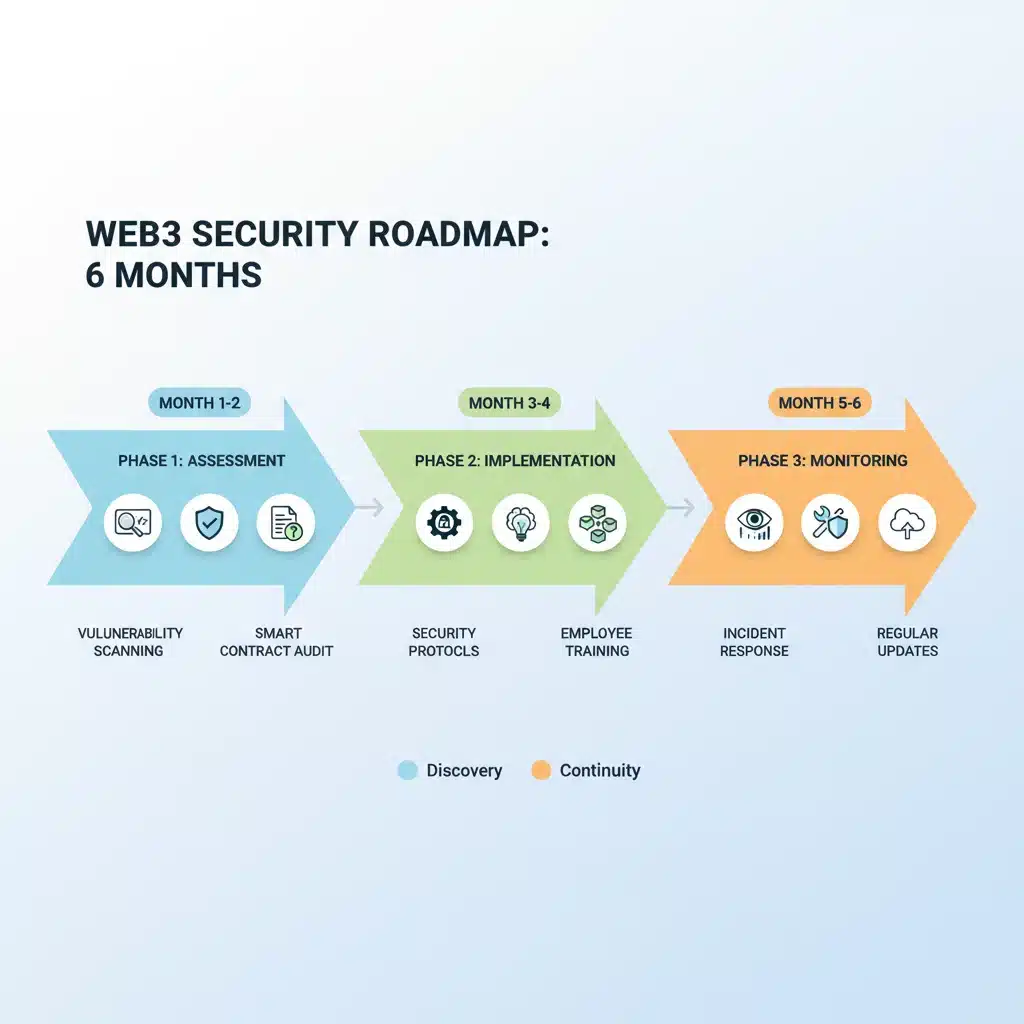
Phase 2: Implementation & Hardening (Months 3-4)
This phase is about actively implementing the identified security measures and hardening the Web3 infrastructure.
Month 3: Smart Contract & Protocol Hardening
- Mandatory Smart Contract Audits: Engage reputable third-party auditors to conduct thorough security audits of all critical smart contracts before deployment. These audits should go beyond automated tools to include manual code review and economic analysis.
- Formal Verification for Critical Smart Contracts: For extremely high-value or high-risk smart contracts, explore formal verification techniques to mathematically prove their correctness and absence of vulnerabilities.
- Implement Secure Coding Standards: Enforce strict secure coding guidelines for all Web3 development, including known patterns for preventing common vulnerabilities (e.g., reentrancy guards, checks-effects-interactions pattern).
- Decentralized Access Control Mechanisms: Implement robust access control for dApps and Web3 resources using decentralized identity solutions and role-based access control (RBAC) where appropriate.
- Integrate Oracle Security Best Practices: If using oracles, ensure they are reputable, decentralized, and employ multiple data sources with aggregation mechanisms to prevent single points of failure or manipulation.
Month 4: Infrastructure Security & Monitoring Tools
- Secure Blockchain Node Infrastructure: For enterprises running their own nodes, ensure they are securely configured, regularly patched, and protected against network attacks (e.g., DDoS). Implement robust firewall rules and intrusion detection systems.
- Implement On-Chain Monitoring Solutions: Deploy tools that continuously monitor blockchain transactions, smart contract events, and network activity for suspicious patterns or anomalies. This includes monitoring for large outflows, unusual contract calls, or rapid changes in token balances.
- Establish Off-Chain Threat Intelligence Integration: Integrate Web3-specific threat intelligence feeds to stay updated on emerging vulnerabilities, exploits, and attack campaigns. This proactive intelligence is vital for the Web3 Security Roadmap.
- Secure Development Environment (SDE) for Web3: Create isolated and secure development environments for Web3 projects to prevent supply chain attacks and unauthorized code injections.
- Implement Decentralized Storage Solutions (if applicable): If utilizing decentralized storage, ensure data integrity, availability, and access control mechanisms are properly configured.
Phase 3: Optimization & Future-Proofing (Months 5-6)
The final phase focuses on continuous improvement, adaptation, and preparing for future Web3 security challenges.
Month 5: Advanced Testing & Compliance Review
- Regular Penetration Testing and Red Teaming: Conduct periodic, external penetration tests and red teaming exercises specifically targeting your Web3 applications and infrastructure. These should simulate real-world attacks.
- Bug Bounty Programs: Launch or participate in bug bounty programs for critical smart contracts and dApps. This leverages the collective intelligence of the white-hat hacker community to discover vulnerabilities.
- Compliance Audit and Reporting: Conduct an internal audit to ensure adherence to all relevant Web3 security policies and regulatory requirements. Prepare documentation for potential external audits.
- Review and Update Incident Response Plan: Based on testing results and new threat intelligence, refine the Web3 incident response plan, including playbooks for different types of Web3 exploits.
- Decentralized Autonomous Organization (DAO) Governance Security (if applicable): For enterprises involved in DAOs, establish robust governance security protocols, including secure voting mechanisms, multi-sig requirements for treasury operations, and clear proposal processes.
Month 6: Continuous Improvement & Future Readiness
- Establish a Continuous Security Monitoring Framework: Implement automated tools for continuous scanning of smart contracts, dApps, and blockchain infrastructure for new vulnerabilities.
- Ongoing Threat Intelligence & Research: Dedicate resources to continuously monitor the Web3 security landscape, research emerging attack techniques, and evaluate new security tools and protocols. This is crucial for maintaining an effective Web3 Security Roadmap.
- Performance and Security Benchmarking: Benchmark your Web3 security posture against industry best practices and peer organizations. Identify areas for further improvement.
- Explore Post-Quantum Cryptography (PQC) Readiness: Begin researching and planning for the eventual transition to post-quantum cryptographic algorithms, especially for long-term data protection and key management.
- Feedback Loop and Iteration: Establish a feedback loop between the security team, development teams, and business units to continuously refine security policies, processes, and tools. Web3 security is an iterative process.

Key Pillars of a Resilient Web3 Security Posture
Beyond the roadmap, several foundational pillars underpin a truly resilient Web3 Security Roadmap for U.S. enterprises:
1. Education and Talent Development
The scarcity of Web3 security experts is a significant challenge. Enterprises must invest heavily in training existing cybersecurity teams in blockchain fundamentals, smart contract auditing, and decentralized security models. Fostering a culture of security awareness across all departments, from developers to executives, is paramount.
2. Proactive Threat Intelligence
The Web3 space moves at an accelerated pace. Subscribing to specialized Web3 threat intelligence feeds, participating in security communities, and conducting internal research are critical for staying ahead of new vulnerabilities and attack techniques. This includes monitoring for zero-day exploits and understanding the economic incentives driving attacks.
3. Robust Governance and Compliance
Clear internal governance structures for Web3 projects, including decision-making processes for smart contract upgrades, treasury management, and incident response, are essential. Simultaneously, a deep understanding and continuous monitoring of the evolving regulatory landscape (e.g., SEC, FinCEN, OFAC) is non-negotiable for U.S. enterprises to avoid legal pitfalls and reputational damage. Integrating legal counsel early into the Web3 Security Roadmap is crucial.
4. Immutable-First Security Design
Embrace the immutable nature of blockchain in security design. While upgrades are sometimes necessary, strive to minimize mutable components and design smart contracts with security from the ground up, making them as simple and auditable as possible. The principle of least privilege should be applied rigorously to all Web3 interactions and access controls.
5. Economic Security Considerations
Web3 security extends beyond technical vulnerabilities to include economic incentives. Enterprises must consider the economic game theory of their Web3 applications, identifying potential vectors for economic manipulation, flash loan attacks, or arbitrage opportunities that could be exploited. This involves understanding the value flow within the dApp and the potential for profit-driven attacks.
6. Decentralization as a Security Feature
While decentralization introduces complexity, it also offers inherent security advantages by eliminating single points of failure. Enterprises should leverage decentralization where appropriate, for example, by using decentralized oracle networks, distributed storage solutions, and multi-signature governance models to enhance resilience against attacks.
Challenges and Considerations for U.S. Enterprises
Implementing a Web3 Security Roadmap is not without its challenges:
- Talent Gap: The demand for skilled Web3 security professionals far outstrips supply. Enterprises may need to invest heavily in training or seek specialized external consultants.
- Rapid Evolution: The Web3 ecosystem is constantly evolving, with new protocols, platforms, and attack vectors emerging regularly. This requires continuous adaptation and a flexible security strategy.
- Regulatory Uncertainty: The regulatory environment for Web3 in the U.S. is still developing, creating uncertainty for compliance teams. Enterprises must adopt a proactive and adaptive approach to legal and regulatory adherence.
- Complexity: Web3 systems are inherently complex, involving multiple layers of technology (blockchain, smart contracts, dApps, oracles, bridges). Securing this intricate stack requires deep technical understanding.
- Interoperability Risks: As enterprises integrate across different blockchains and protocols, the risks associated with cross-chain communication and bridge security become more pronounced.
Conclusion
The integration of Web3 technologies presents both unprecedented opportunities and significant security challenges for U.S. enterprises. A proactive, structured, and comprehensive approach is essential to navigate this evolving landscape securely. The 6-month Web3 Security Roadmap outlined in this article provides a practical framework for organizations to assess their risks, implement robust security protocols, and continuously adapt to new threats by 2026.
By prioritizing smart contract auditing, secure key management, continuous monitoring, and a strong culture of security awareness, enterprises can build a resilient Web3 posture. Furthermore, investing in talent development, staying abreast of regulatory changes, and embracing the unique security paradigms of decentralized systems will be critical for long-term success. The time to act is now; securing your Web3 future begins with a strategic roadmap and unwavering commitment to excellence in cybersecurity.