Generative AI in Content Creation: Expert Tips for U.S. Marketers to Reduce Production Costs by 18% in 2026

In the rapidly evolving landscape of digital marketing, U.S. marketers are constantly seeking innovative solutions to enhance efficiency, scale operations, and, crucially, reduce costs without compromising quality. The advent of generative AI has emerged as a game-changer, promising not just incremental improvements but a transformative shift in how content is conceived, produced, and disseminated. Industry experts and analysts predict that by 2026, U.S. marketers who strategically integrate generative AI marketing into their content creation workflows could see an impressive 18% reduction in production costs. This isn’t merely a futuristic fantasy; it’s a tangible goal achievable through informed strategies and careful implementation.
This comprehensive guide delves into the core of generative AI marketing, offering expert tips and insider knowledge for U.S. marketers aiming to harness its power. We’ll explore how AI can streamline various stages of content creation, from ideation and drafting to optimization and localization, ultimately leading to significant cost efficiencies and a competitive edge.
Understanding the Generative AI Revolution in Marketing
Generative AI, a subset of artificial intelligence, is designed to create new, original content rather than just analyzing or processing existing data. This includes text, images, audio, and video. For marketers, this technology offers unprecedented opportunities to automate mundane tasks, accelerate content production cycles, and even generate novel creative concepts. The implications for cost reduction are profound: less time spent on manual drafting, fewer resources allocated to repetitive tasks, and the ability to scale content output without a proportional increase in human capital.
The shift towards generative AI marketing is not about replacing human creativity but augmenting it. AI tools can act as powerful co-pilots, handling the heavy lifting of initial drafts, brainstorming ideas, and optimizing content for specific platforms or audiences. This frees up human marketers to focus on higher-level strategic thinking, creative direction, and building authentic connections with their audience. The synergy between human ingenuity and AI efficiency is where the true value lies, especially for those looking to achieve substantial cost savings.
The Current Landscape: Why U.S. Marketers Need Generative AI Now
The U.S. marketing landscape is characterized by intense competition, ever-increasing demand for personalized content, and tight budgets. Consumers expect a constant stream of fresh, relevant, and engaging material across multiple channels. Meeting these demands with traditional methods often requires significant investment in human resources, agency fees, and licensing. This is where generative AI marketing steps in as a critical enabler.
Consider the sheer volume of content required for a multi-channel campaign: blog posts, social media updates, email newsletters, ad copy, video scripts, and more. Manually producing all this content can be time-consuming and expensive. Generative AI can rapidly produce variations of ad copy, tailor email subject lines to individual segments, generate initial drafts of blog articles, and even create unique visual assets, all at a fraction of the cost and time. This capability is not just about doing more with less; it’s about doing more, better, and faster, ultimately leading to that coveted 18% cost reduction by 2026.
Strategic Implementation: Expert Tips for Cost-Effective Generative AI Marketing
Achieving significant cost reductions with generative AI marketing requires more than just adopting a new tool; it demands a strategic approach. Here are expert tips for U.S. marketers to maximize their ROI:
1. Start Small, Scale Smart: Phased Adoption
Don’t attempt a complete overhaul of your content strategy overnight. Begin by identifying specific, high-volume, low-complexity tasks where AI can make an immediate impact. Examples include generating meta descriptions, social media captions, or initial drafts for product descriptions. As your team gains familiarity and confidence with the technology, gradually expand its application to more complex tasks. This phased approach minimizes disruption and allows for continuous learning and optimization, ensuring that your generative AI marketing efforts are both effective and sustainable.
2. Focus on Augmentation, Not Replacement
The most successful implementations of generative AI don’t aim to replace human roles but to augment them. Train your team to work alongside AI tools. For instance, instead of having a copywriter start from a blank page, they can use AI to generate several initial drafts, then refine, personalize, and inject their unique brand voice. This collaborative model leverages AI’s speed and efficiency while preserving human creativity, critical thinking, and emotional intelligence. The result is higher quality content produced faster and at a lower cost.
3. Define Clear Use Cases and KPIs
Before implementing any generative AI marketing tool, clearly define what problems you’re trying to solve and what metrics will define success. Are you aiming to reduce content production time? Increase content volume? Improve personalization at scale? By setting specific Key Performance Indicators (KPIs), such as ‘reduce time spent on first drafts by 30%’ or ‘increase social media post frequency by 50%’, you can accurately measure the impact of your AI investments and demonstrate their value in cost savings.
4. Invest in Training and Upskilling Your Team
The effectiveness of generative AI marketing is directly proportional to your team’s ability to use it. Provide comprehensive training on how to prompt AI effectively, evaluate its output, and integrate AI-generated content into existing workflows. Upskilling your team in ‘prompt engineering’ – the art and science of crafting effective AI prompts – is crucial. A well-crafted prompt can yield high-quality, relevant content, while a poorly designed one can lead to generic or unusable output, negating any potential cost savings.
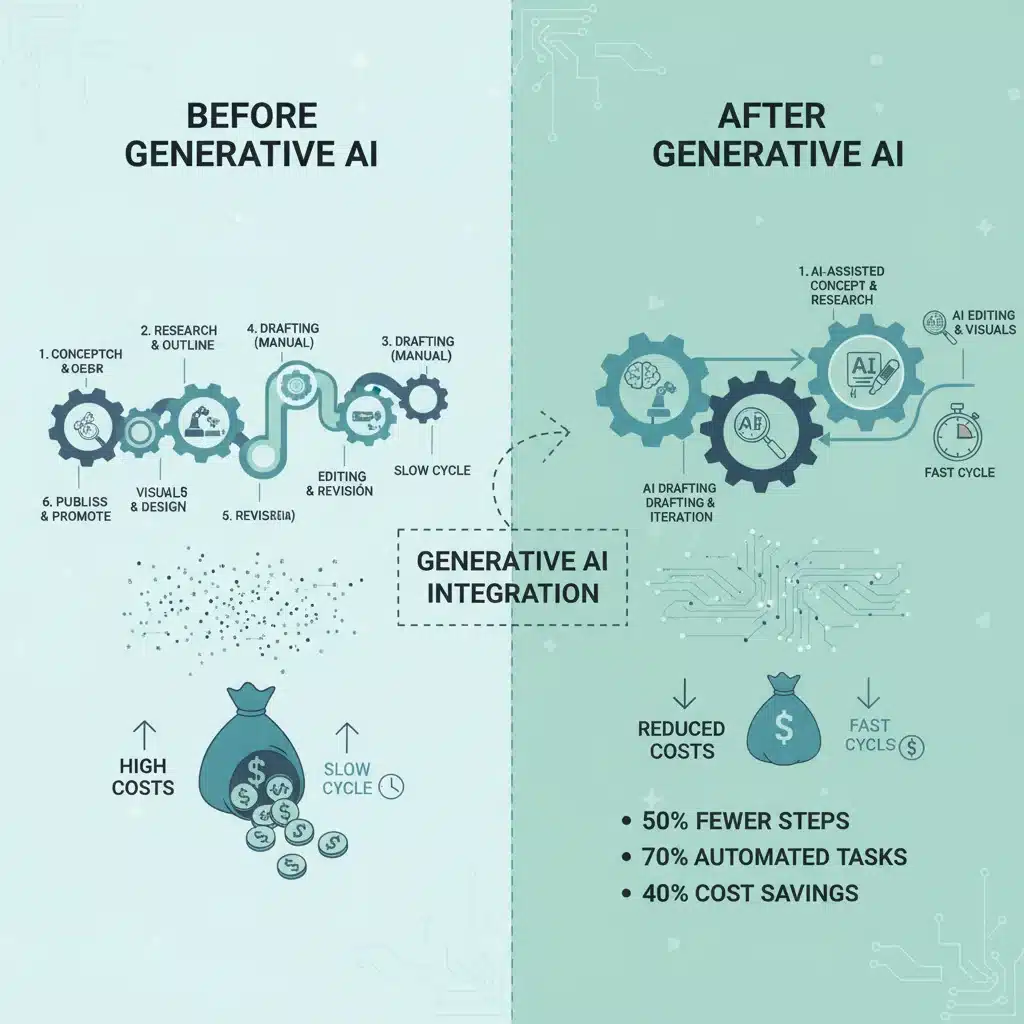
Leveraging Generative AI Across the Content Lifecycle for Cost Reduction
Let’s break down specific areas where generative AI marketing can significantly reduce costs across the content lifecycle:
Ideation and Brainstorming: Faster Concept Generation
Gone are the days of endless brainstorming sessions yielding minimal results. Generative AI can quickly generate hundreds of content ideas, headlines, and angles based on target keywords, audience demographics, and trending topics. This dramatically reduces the time and human effort spent in the initial, often slow, ideation phase. By providing a diverse set of starting points, AI empowers marketers to select the most promising concepts, saving valuable creative hours.
Content Drafting: Accelerating Production
This is perhaps the most obvious area for cost savings. AI models can generate first drafts of articles, blog posts, email copy, social media updates, and even video scripts in minutes. While these drafts will almost always require human refinement, they provide a solid foundation, eliminating the need to start from scratch. This can cut drafting time by 50% or more, allowing content creators to focus on adding nuance, brand voice, and strategic depth. For U.S. marketers, this means producing more content with the same or even fewer resources, directly contributing to cost reduction in generative AI marketing.
Personalization and Localization: Tailoring at Scale
Personalized content drives higher engagement and conversion rates, but creating tailored content for numerous segments or different geographical regions has traditionally been resource-intensive. Generative AI can dynamically adapt content to specific audience segments, linguistic nuances, and cultural contexts. Imagine generating 10 variations of an ad campaign for different U.S. states, each with localized language and references, in a fraction of the time it would take human copywriters. This level of scalable personalization is a significant cost-saver, improving campaign effectiveness without ballooning budgets.
SEO Optimization: Built-in Efficiency
Many generative AI marketing tools are now integrated with SEO functionalities. They can suggest keywords, optimize meta descriptions, generate internal link suggestions, and even analyze competitor content for gaps. By automating these SEO tasks, marketers can ensure their content is discoverable and ranks well without requiring extensive manual research or specialized SEO agency fees. This integrated approach not only saves costs but also improves content performance, driving organic traffic more efficiently.
Content Repurposing: Maximizing Asset Value
Creating evergreen content is a smart strategy, but repurposing it for different platforms and formats often requires significant effort. Generative AI can take a long-form blog post and automatically generate social media snippets, email blurbs, podcast outlines, or even short video scripts. This maximizes the value of each piece of content, extending its reach and lifespan without incurring the cost of creating entirely new assets. This is a crucial aspect of efficient generative AI marketing.
Insider Knowledge: Overcoming Challenges and Maximizing ROI
While the benefits of generative AI marketing are clear, U.S. marketers must also be aware of potential pitfalls and how to navigate them to truly achieve that 18% cost reduction.
Maintaining Brand Voice and Quality Control
One of the primary concerns with AI-generated content is the potential for a loss of unique brand voice or a dip in quality. This is where human oversight becomes paramount. AI tools should be viewed as assistants, not autonomous creators. Implement a robust editorial process where human editors review, refine, and ensure all AI-generated content aligns with brand guidelines, tone, and factual accuracy. Developing a comprehensive style guide and providing AI with examples of your brand’s voice can significantly improve output quality.
Ethical Considerations and Bias Mitigation
Generative AI models learn from vast datasets, which can sometimes contain biases. Marketers must be vigilant in reviewing AI-generated content for unintended biases, stereotypes, or inappropriate language. Establishing ethical guidelines for AI use and regularly auditing content for fairness and inclusivity is critical. Responsible generative AI marketing ensures that your brand maintains its reputation and avoids alienating audiences.
Data Security and Privacy
When using AI tools, especially cloud-based ones, ensure that your data – particularly sensitive customer information or proprietary brand strategies – is handled securely and in compliance with privacy regulations (e.g., CCPA, GDPR). Choose reputable AI vendors with strong data protection policies and consider on-premise solutions for highly sensitive data if feasible. Protecting your data is not just an ethical imperative but a legal and financial one.
Integration with Existing MarTech Stack
The true power of generative AI marketing is unleashed when it seamlessly integrates with your existing marketing technology (MarTech) stack. Look for AI tools that offer APIs or direct integrations with your CMS, CRM, email marketing platforms, and analytics dashboards. Smooth integration minimizes manual data transfer, reduces errors, and streamlines workflows, further contributing to efficiency and cost savings.

The Future is Now: Preparing for 2026 and Beyond
The projected 18% cost reduction by 2026 is just the beginning. As generative AI technology continues to advance, its capabilities will become even more sophisticated, offering greater opportunities for efficiency and innovation. U.S. marketers who embrace this technology early and strategically will be best positioned to reap its full benefits.
Looking ahead, expect generative AI marketing to move beyond text and image generation to more complex tasks like personalized video creation, interactive content development, and even full campaign ideation and execution. The ability to hyper-personalize content at scale will become a baseline expectation, and AI will be the engine driving this capability. Marketers who master the art of human-AI collaboration will find themselves with a significant competitive advantage, capable of producing high-quality, high-volume content that resonates deeply with their target audiences, all while maintaining a lean and efficient operation.
Measuring Success and Iterating
To truly achieve and sustain cost reductions, continuously monitor the performance of your generative AI marketing initiatives. Track the KPIs you established earlier. Are you meeting your goals for reduced production time? Is content volume increasing? Are engagement rates improving? Use this data to iterate and refine your AI strategies. Experiment with different AI tools, prompting techniques, and workflow integrations. The field of AI is dynamic, and continuous adaptation is key to long-term success and maximizing your return on investment.
Conclusion: The Path to 18% Cost Reduction with Generative AI
For U.S. marketers, the promise of an 18% reduction in content production costs by 2026 through generative AI marketing is not an outlandish claim but a realistic and achievable goal. By strategically implementing AI tools, focusing on augmentation, defining clear objectives, investing in team training, and maintaining rigorous quality control, businesses can unlock unprecedented efficiencies. The future of content creation is collaborative, with AI acting as a powerful ally, freeing up human creativity and enabling marketers to do more with less. Embrace generative AI now, and position your brand at the forefront of marketing innovation and cost-effectiveness.