Edge Computing Adoption: Why 20% More US Companies Will Rely on Local Data Processing by Q3 2026

In an increasingly data-driven world, the way businesses collect, process, and analyze information is undergoing a profound transformation. The traditional model of sending all data to a centralized cloud or data center is proving insufficient for the demands of modern applications and the sheer volume of data generated at the periphery of networks. This is where Edge Computing Adoption comes into play, a paradigm shift that brings computation and data storage closer to the sources of data. The United States is at the forefront of this revolution, with projections indicating a significant surge in its implementation. By Q3 2026, it is estimated that an additional 20% of US companies will have embraced local data processing through edge computing, fundamentally altering their operational landscapes and competitive strategies.
This article will delve deep into the phenomenon of Edge Computing Adoption, exploring the catalysts behind its rapid growth, the myriad benefits it offers, and the challenges companies must navigate to successfully integrate this technology. We will examine the specific industries poised for the most significant impact and discuss the strategic implications for businesses looking to stay ahead in a fast-evolving digital economy.
The Imperative for Local Data Processing: Why Edge Computing is Gaining Traction
The rise of the Internet of Things (IoT), artificial intelligence (AI), and 5G networks has created an unprecedented explosion of data. From smart factories and autonomous vehicles to connected healthcare devices and intelligent retail environments, data is being generated at an exponential rate. Traditional cloud computing, while powerful, often struggles to keep pace with the real-time processing requirements and bandwidth limitations associated with this deluge of information. This is where the core value proposition of Edge Computing Adoption emerges.
Reduced Latency and Real-time Decision Making
One of the most compelling drivers for Edge Computing Adoption is the critical need for reduced latency. Applications such as autonomous driving, remote surgery, and industrial automation demand immediate responses. Sending data to a distant cloud server for processing and then awaiting a response can introduce delays that are simply unacceptable, potentially leading to safety hazards or operational inefficiencies. By processing data at the edge, milliseconds can be shaved off response times, enabling real-time decision-making and enhancing the responsiveness of critical systems.
Bandwidth Optimization and Cost Savings
Transporting vast quantities of raw data from the edge to the cloud can be incredibly bandwidth-intensive and, consequently, expensive. Edge Computing Adoption allows for data to be filtered, aggregated, and processed locally, sending only relevant or summarized insights to the central cloud. This significantly reduces the volume of data transmitted, thereby optimizing network bandwidth usage and lowering data transmission costs. For businesses operating in remote areas with limited connectivity, this benefit is particularly pronounced, making edge computing an economic necessity.
Enhanced Security and Data Privacy
Data security and privacy are paramount concerns for businesses across all sectors. By processing sensitive data closer to its source and minimizing its transit across networks, Edge Computing Adoption can inherently enhance security. It reduces the attack surface and the potential for data breaches that can occur during transmission to a central cloud. Furthermore, for industries subject to stringent data residency and privacy regulations (like GDPR or HIPAA), local data processing at the edge can help ensure compliance by keeping sensitive information within specified geographical boundaries or organizational control.
Improved Reliability and Offline Capabilities
Reliance on a constant, high-speed connection to the cloud can be a single point of failure. Network outages or intermittent connectivity can cripple operations that depend entirely on cloud services. Edge Computing Adoption provides a layer of resilience, allowing critical operations to continue even if the connection to the central cloud is temporarily lost. Edge devices can operate autonomously, processing data and executing tasks locally, ensuring business continuity and operational stability.
Key Industries Driving Edge Computing Adoption in the US
While the benefits of edge computing are universal, certain sectors are experiencing a more urgent need and are thus leading the charge in Edge Computing Adoption. The projected 20% increase in US companies by Q3 2026 will largely be spearheaded by these industries.
Manufacturing and Industrial Automation
The manufacturing sector is a prime candidate for Edge Computing Adoption. Smart factories, powered by Industry 4.0 principles, generate enormous amounts of data from sensors on machinery, robotic arms, and quality control systems. Edge computing enables real-time monitoring, predictive maintenance, and immediate process adjustments. For instance, an edge device can analyze sensor data from a machine to detect anomalies indicating impending failure, triggering an alert or even shutting down the machine before a costly breakdown occurs. This level of responsiveness is impossible with cloud-only processing.

Retail and Smart Stores
In the retail sector, Edge Computing Adoption is transforming customer experiences and operational efficiency. Edge devices can power intelligent cameras for inventory management, customer behavior analytics, and loss prevention. They can also facilitate personalized recommendations, contactless payments, and smart shelf technology, all requiring low-latency processing to be effective. Processing this data at the store level rather than sending it all to a central cloud ensures faster insights and more immediate actions, leading to improved customer satisfaction and optimized store operations.
Healthcare and Remote Patient Monitoring
The healthcare industry is witnessing a significant push towards Edge Computing Adoption, particularly in areas like remote patient monitoring, telemedicine, and smart hospitals. Wearable devices and medical sensors generate continuous streams of vital data. Processing this data at the edge can enable immediate alerts for critical health events, reduce the burden on central data centers, and ensure patient data privacy by keeping sensitive information localized. The low latency provided by edge computing is crucial for life-saving applications and real-time diagnostic support.
Transportation and Autonomous Vehicles
Autonomous vehicles are perhaps the most compelling use case for edge computing. These vehicles generate terabytes of data per hour from cameras, LiDAR, radar, and other sensors. Real-time decision-making for navigation, obstacle detection, and collision avoidance is absolutely critical and cannot tolerate any latency. Edge Computing Adoption is fundamental here, allowing vehicles to process data locally and make instantaneous decisions, ensuring safety and efficiency on the roads. Smart city initiatives also leverage edge computing for traffic management, public safety, and environmental monitoring.
Oil & Gas and Remote Operations
For industries with extensive remote operations, such as oil and gas, mining, and utilities, Edge Computing Adoption offers immense value. These environments often have limited or unreliable network connectivity. Edge devices can monitor equipment performance, detect anomalies, and optimize operations locally, even when disconnected from the central network. This reduces the need for constant human intervention in hazardous areas, improves safety, and minimizes downtime.
Challenges in Edge Computing Adoption
Despite the compelling advantages, the path to widespread Edge Computing Adoption is not without its hurdles. Organizations must carefully consider and address these challenges to ensure successful implementation.
Deployment and Management Complexity
Deploying and managing a distributed network of edge devices can be significantly more complex than managing a centralized cloud infrastructure. Edge environments often consist of a diverse array of hardware and software from multiple vendors, requiring specialized skills for installation, configuration, and maintenance. Ensuring consistent security, software updates, and operational continuity across a vast number of geographically dispersed edge locations presents a substantial management challenge.
Security Concerns at the Edge
While edge computing can enhance certain aspects of security by localizing data, it also introduces new vulnerabilities. Edge devices are often deployed in less secure physical environments than centralized data centers, making them susceptible to physical tampering or theft. Moreover, securing a multitude of diverse edge devices against cyber threats requires robust authentication, encryption, and continuous monitoring strategies. The sheer number of endpoints can make comprehensive security challenging.
Interoperability and Standardization
The nascent nature of the edge computing market means there’s a lack of universal standards for hardware, software, and communication protocols. This can lead to interoperability issues between different vendors’ solutions, making it difficult to integrate disparate systems and scale deployments. Organizations embarking on Edge Computing Adoption need to carefully consider vendor lock-in and seek solutions that offer flexibility and open standards where possible.
Data Governance and Compliance at Scale
Managing data governance, compliance, and privacy across a distributed edge infrastructure adds another layer of complexity. Ensuring that data is processed, stored, and transmitted in accordance with regulatory requirements (e.g., GDPR, CCPA) at each edge location, and then consistently aggregated or summarized for the cloud, demands meticulous planning and robust data management policies. This is particularly challenging for multi-national corporations or those operating in highly regulated industries.
Talent Gap and Skill Shortages
The specialized skills required to design, deploy, and manage edge computing solutions are currently in high demand and short supply. Expertise in areas such as IoT architecture, embedded systems, network security, and distributed computing is crucial. Organizations looking to accelerate their Edge Computing Adoption will need to invest in training their existing workforce or actively recruit professionals with these specialized capabilities.
Strategies for Successful Edge Computing Adoption
To overcome these challenges and successfully capitalize on the benefits of edge computing, companies need a strategic approach. The following strategies can pave the way for effective Edge Computing Adoption.
Start Small and Scale Incrementally
Instead of attempting a large-scale deployment from the outset, businesses should consider starting with pilot projects in specific use cases where edge computing offers the most immediate and tangible benefits. This allows organizations to gain experience, refine their strategies, and demonstrate ROI before scaling up. An incremental approach minimizes risk and provides valuable learning opportunities.
Prioritize Security from Day One
Security should be an integral part of the edge computing strategy from the initial design phase. This includes implementing robust authentication mechanisms, encryption for data at rest and in transit, intrusion detection systems, and regular security audits for all edge devices. A ‘zero-trust’ security model, where every device and user is verified regardless of their location, is particularly relevant for distributed edge environments.
Leverage Automation and Orchestration Tools
To manage the complexity of a distributed edge infrastructure, automation and orchestration tools are indispensable. These tools can help with automated deployment, configuration management, software updates, and remote monitoring of edge devices. This reduces the manual effort required, improves efficiency, and ensures consistency across the entire edge ecosystem.
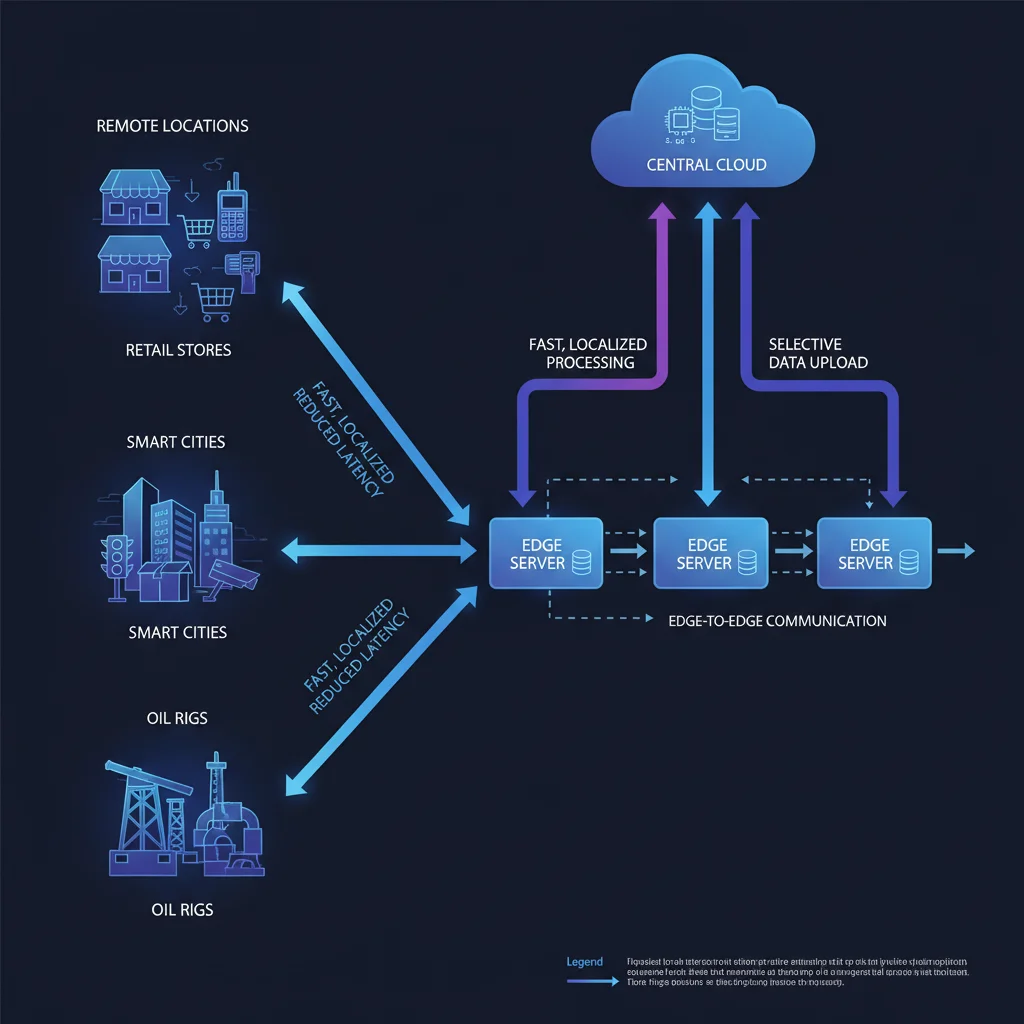
Embrace Hybrid Cloud and Edge Architectures
Edge computing is not a replacement for cloud computing; rather, it is a complementary technology. A successful strategy for Edge Computing Adoption often involves a hybrid architecture where edge devices handle real-time, latency-sensitive tasks, while the cloud provides centralized storage, heavy-duty analytics, and long-term data archival. Seamless integration between edge and cloud components is crucial for a unified data strategy.
Invest in Training and Skill Development
Addressing the talent gap is critical. Companies should invest in training programs for their IT and operational staff to equip them with the necessary skills for managing edge environments. Collaborating with technology partners and vendors who offer expertise in edge computing can also help bridge the skill deficit.
The Future Landscape: Beyond 2026 for Edge Computing Adoption
The projection of 20% more US companies adopting edge computing by Q3 2026 is just the beginning. The trajectory for Edge Computing Adoption suggests a future where this technology becomes an indispensable component of virtually every industry. As 5G networks become more pervasive, offering ultra-low latency and massive connectivity, the capabilities of edge computing will only expand further. We can anticipate even more sophisticated applications emerging, from highly localized AI models running directly on edge devices to fully autonomous systems operating with minimal human intervention.
The evolution of edge computing hardware, with more powerful and energy-efficient processors tailored for edge environments, will also play a significant role. Software advancements, particularly in areas like containerization, serverless functions at the edge, and intelligent orchestration, will continue to simplify deployment and management, making edge computing more accessible to a broader range of organizations.
Furthermore, the convergence of edge computing with other emerging technologies like quantum computing and advanced robotics will unlock unprecedented possibilities. Imagine quantum-enhanced edge devices performing complex optimizations in real-time for critical infrastructure, or swarms of robots coordinating their actions with hyper-local processing. The potential for innovation driven by increased Edge Computing Adoption is truly limitless.
Conclusion
The shift towards local data processing is not merely a technological trend; it’s a fundamental re-architecture of how businesses operate in the digital age. The anticipated 20% increase in Edge Computing Adoption by US companies by Q3 2026 underscores its growing importance as a strategic imperative. From enhancing real-time decision-making and optimizing bandwidth to bolstering security and ensuring operational resilience, the benefits are clear and compelling.
While challenges related to complexity, security, and talent must be addressed, a well-planned and incremental approach, coupled with strategic investments in technology and people, can pave the way for successful implementation. As we move further into the era of pervasive connectivity and intelligent automation, edge computing will be the backbone that enables businesses to harness the full potential of their data, driving innovation, efficiency, and competitive advantage in an increasingly dynamic global marketplace. Companies that embrace Edge Computing Adoption now will undoubtedly be better positioned to thrive in the future.