Sustainable Energy Storage: 3 Breakthroughs Impacting the US Grid in the Next 12 Months
Sustainable Energy Storage: 3 Breakthroughs Impacting the US Grid in the Next 12 Months
The quest for a fully decarbonized and resilient energy system is more urgent than ever. At the heart of this transformation lies sustainable energy storage – the critical technology that enables the reliable integration of intermittent renewable sources like solar and wind. Without effective storage, the promise of a truly green grid remains elusive. The United States, with its vast geographical expanse and diverse energy demands, is a pivotal battleground for these innovations. The next 12 months are poised to unveil and accelerate the deployment of several groundbreaking sustainable energy storage technologies that will fundamentally reshape the US grid. This article delves into three such breakthroughs, exploring their potential impact, the science behind them, and the challenges that still lie ahead.
The Imperative of Sustainable Energy Storage for the US Grid
The current US energy landscape is undergoing a dramatic shift. Coal-fired power plants are retiring, natural gas continues to play a significant role, and renewable energy sources are rapidly expanding. However, the inherent variability of solar and wind power presents a significant challenge to grid stability. When the sun isn’t shining or the wind isn’t blowing, backup power is needed. Conversely, when renewable generation is high, but demand is low, excess energy must be stored or curtailed, leading to wasted potential.
This is where sustainable energy storage steps in. It acts as the buffer, absorbing excess energy when plentiful and discharging it when needed, thereby balancing supply and demand. Beyond simply integrating renewables, robust energy storage systems offer a myriad of benefits: enhanced grid resilience against extreme weather events, reduced transmission congestion, improved power quality, and the ability to defer costly infrastructure upgrades. The transition to a clean energy economy hinges on our ability to store energy efficiently, economically, and sustainably. The breakthroughs we are about to discuss are not just incremental improvements; they represent paradigm shifts that could accelerate this transition significantly.
Breakthrough 1: The Maturation and Scaling of Solid-State Batteries
For years, solid-state batteries have been hailed as the ‘holy grail’ of battery technology, promising higher energy density, faster charging times, and significantly improved safety compared to conventional lithium-ion batteries. While their widespread commercialization has been a long time coming, the next 12 months are expected to see significant maturation and scaling efforts, bringing them closer to grid-scale deployment and making them a key player in sustainable energy storage.
The Promise of Solid-State Technology
Traditional lithium-ion batteries use a liquid or gel electrolyte that can be flammable and prone to dendrite formation, which can lead to short circuits and thermal runaway. Solid-state batteries, as their name suggests, replace this liquid with a solid electrolyte. This fundamental change offers several advantages:
- Enhanced Safety: The solid electrolyte is non-flammable, significantly reducing the risk of fires and explosions. This is particularly crucial for large-scale grid applications where safety is paramount.
- Higher Energy Density: Solid electrolytes can enable the use of lithium metal anodes, which have a theoretical energy density far superior to the graphite anodes used in current lithium-ion batteries. This means more energy can be packed into a smaller, lighter footprint – a significant advantage for space-constrained grid applications.
- Longer Lifespan: The solid electrolyte can mitigate dendrite growth, leading to improved cycle life and calendar life, reducing the need for frequent replacements and lowering overall operational costs.
- Faster Charging: Some solid-state battery designs promise ultra-fast charging capabilities, which could be beneficial for certain grid services requiring rapid response.
Recent Advancements and What to Expect
In the past year, several companies have made substantial strides in overcoming the manufacturing challenges associated with solid-state batteries. Researchers have developed new solid electrolyte materials that offer high ionic conductivity at room temperature, addressing a key hurdle. Furthermore, advancements in manufacturing techniques, such as roll-to-roll processing and innovative deposition methods, are paving the way for larger-scale production.
Over the next 12 months, we can anticipate:
- Pilot Projects and Demonstrations: Expect to see more pilot projects in the US showcasing solid-state battery technology for grid support, particularly in niche applications where their unique properties (safety, energy density) are highly valued.
- Strategic Partnerships and Investments: Major energy companies and automotive manufacturers (who are also heavily invested in solid-state for EVs) will likely announce further strategic partnerships and investments, signaling confidence in the technology’s readiness for scaling.
- Improved Cost Projections: As manufacturing processes become more refined, cost projections for solid-state batteries will likely become more competitive, moving them closer to economic viability for broader grid deployment.

The impact of solid-state batteries on sustainable energy storage will be profound. Their enhanced safety and energy density make them ideal for urban substations or areas with limited space. Their longer lifespan also contributes to a more sustainable solution by reducing material consumption over time. While mass production for the grid might still be a few years away, the next 12 months will be crucial in solidifying their position as a leading contender for future grid storage solutions.
Breakthrough 2: The Emergence of Long-Duration Flow Batteries for Grid Stability
While lithium-ion batteries excel at short-to-medium duration storage (typically 2-6 hours), the grid increasingly needs solutions for long-duration storage – holding energy for 8, 12, or even 24 hours to bridge periods of low renewable output or to provide seasonal balancing. Flow batteries are emerging as a highly promising sustainable energy storage technology for this critical role, and significant advancements are expected to accelerate their deployment in the US grid.
Understanding Flow Battery Technology
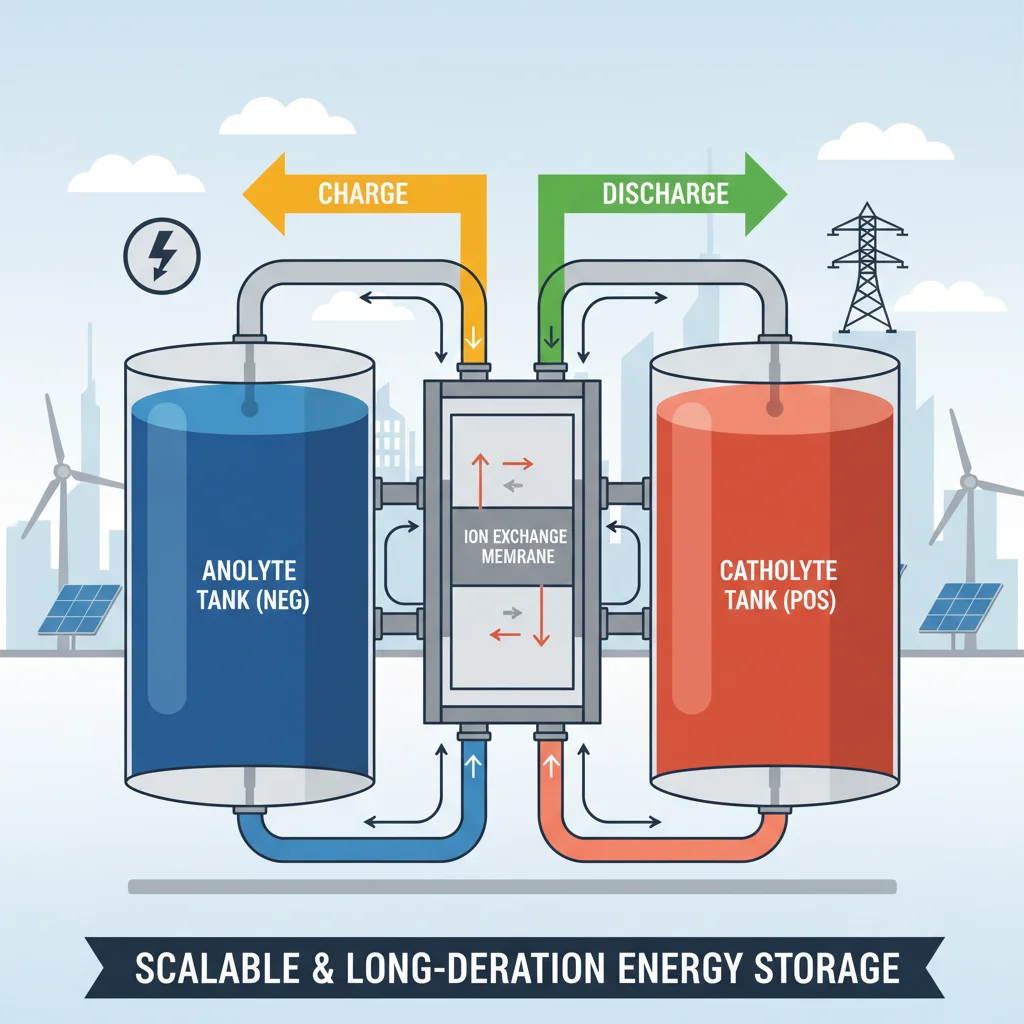
Unlike conventional batteries that store energy within the electrode materials, flow batteries store energy in liquid electrolyte solutions contained in external tanks. These electrolytes are pumped through a central cell stack where electrochemical reactions occur, charging or discharging the battery. The key advantages of flow batteries for long-duration applications include:
- Scalability: The power (cell stack size) and energy (electrolyte tank size) components are decoupled, allowing for independent scaling. This means you can increase storage duration simply by adding larger tanks of electrolyte, making them highly cost-effective for long-duration needs.
- Long Lifespan: Flow batteries typically have a very long cycle life, often tens of thousands of cycles, and can operate for decades with minimal degradation. This contributes significantly to their sustainability and economic viability.
- Safety: Many flow battery chemistries use non-flammable, water-based electrolytes, making them inherently safer than lithium-ion batteries, especially for large installations.
- Deep Discharge Capability: They can be repeatedly discharged to 0% state of charge without significant damage, which is valuable for maximizing stored energy utilization.
Innovations Driving Adoption
Recent breakthroughs in flow battery technology have focused on improving electrolyte chemistries, reducing material costs, and enhancing system efficiency. Vanadium redox flow batteries (VRFBs) have been the most mature, but newer chemistries, such as zinc-bromine, iron-chromium, and organic flow batteries, are gaining traction due to lower material costs and improved performance.
In the next 12 months, we anticipate:
- Increased Commercial Deployments: Several companies are moving beyond pilot projects to larger commercial deployments of flow battery systems across the US, particularly in regions with high renewable penetration and a need for grid firming.
- Cost Reductions through Manufacturing Optimization: Advances in manufacturing techniques for cell stacks and electrolyte production are expected to drive down the installed cost per kilowatt-hour, making flow batteries more competitive with traditional peaker plants.
- Development of Hybrid Systems: We may see more hybrid systems emerging that combine the fast response of lithium-ion batteries with the long-duration capabilities of flow batteries, offering a comprehensive sustainable energy storage solution.
The role of long-duration flow batteries in sustainable energy storage cannot be overstated. They provide the necessary grid stability to move towards very high penetrations of renewable energy, ensuring that power is available even when renewable generation is absent for extended periods. This capability is crucial for achieving energy independence and meeting ambitious decarbonization targets.
Breakthrough 3: Advanced Thermal Energy Storage for Industrial and Grid Applications
While batteries often dominate discussions around sustainable energy storage, thermal energy storage (TES) offers a distinct and highly effective pathway, especially for industrial processes and certain grid applications. Recent advancements in TES technologies, particularly those utilizing novel materials and system designs, are poised to make a significant impact on the US grid within the next year.
The Mechanics and Benefits of Thermal Storage
Thermal energy storage involves heating or cooling a storage medium and then using that stored thermal energy later. This can involve materials like molten salts, concrete, phase-change materials (PCMs), or even compressed air. The stored heat or cold can then be used directly for industrial processes, space heating/cooling, or converted back into electricity via turbines (as in concentrated solar power plants).
Key benefits include:
- High Capacity and Long Duration: TES systems can store very large amounts of energy for extended periods, from hours to days, making them suitable for long-duration applications.
- Cost-Effectiveness: The storage mediums are often inexpensive and abundant (e.g., sand, water, concrete), leading to lower capital costs compared to electrochemical batteries for similar durations.
- Efficiency and Sustainability: Many TES systems can achieve high round-trip efficiencies, and the materials used are often non-toxic and recyclable, contributing to their sustainable energy storage profile.
- Industrial Integration: TES is particularly valuable for industries that require significant amounts of heat or cooling, allowing them to utilize excess renewable electricity to generate and store thermal energy, thus decarbonizing their operations.
Cutting-Edge Innovations and Future Outlook
Recent advancements in TES are focusing on higher temperature materials, more efficient heat exchangers, and integrated system designs. For example, research into advanced PCMs with higher energy densities and tailored melting points is expanding their application range. Similarly, innovations in compressed air energy storage (CAES) are making it more efficient and suitable for longer durations.
In the coming 12 months, we can expect:
- Deployment in Industrial Decarbonization: We will likely see more industrial facilities in the US adopting advanced TES systems to store renewable energy for process heat, reducing their reliance on fossil fuels.
- Hybrid Renewable + TES Projects: New concentrated solar power (CSP) projects or hybrid solar PV + TES facilities will emerge, demonstrating the ability to provide dispatchable, 24/7 renewable power.
- Grid-Scale Demonstrations for Seasonal Storage: While still nascent, there might be initial demonstrations or significant research funding announcements for large-scale, long-duration TES systems aimed at seasonal energy storage, a critical need for a fully renewable grid.
Advanced thermal energy storage offers a complementary approach to electrochemical batteries, particularly for applications requiring large quantities of heat or for very long-duration electricity storage. Its integration into the US grid will not only enhance grid stability but also play a crucial role in decarbonizing hard-to-abate industrial sectors, solidifying its place in the sustainable energy storage ecosystem.
The Broader Impact on the US Grid and Beyond
These three breakthroughs in sustainable energy storage – solid-state batteries, long-duration flow batteries, and advanced thermal storage – are not developing in isolation. Their collective advancement will have a transformative impact on the US grid in several key ways:
- Enhanced Grid Reliability and Resilience: With diverse storage options, the grid will become less susceptible to outages caused by extreme weather or supply-demand imbalances.
- Accelerated Renewable Integration: The ability to store energy for various durations will significantly increase the percentage of intermittent renewables that can be reliably integrated into the grid.
- Reduced Carbon Emissions: By replacing fossil fuel-based generation with stored renewable energy, these technologies will directly contribute to achieving national and international climate goals.
- Economic Benefits: Reduced curtailment of renewables, deferred transmission upgrades, and new market opportunities for grid services will create significant economic value.
- Decentralization and Energy Independence: Robust energy storage enables more localized energy systems, fostering greater energy independence and empowering communities with reliable power.
The next 12 months represent a crucial period for these technologies. Policy support, continued research and development funding, and private sector investment will be vital in translating these breakthroughs from laboratories and pilot projects into widespread commercial deployment. The regulatory landscape also plays a critical role, ensuring that market mechanisms adequately value the services provided by energy storage.
Challenges and the Path Forward for Sustainable Energy Storage
While the outlook is promising, significant challenges remain. Cost remains a primary barrier for many nascent storage technologies. Supply chain issues, particularly for critical minerals used in batteries, need to be addressed through diversification and recycling initiatives. Furthermore, the development of robust grid infrastructure capable of intelligently managing and dispatching these diverse storage assets is essential.
Overcoming these challenges will require a concerted effort from policymakers, researchers, industry leaders, and investors. Investment in domestic manufacturing capabilities for sustainable energy storage technologies will be crucial for national energy security and economic growth. Additionally, fostering collaboration between different sectors – from materials science to grid operators – will accelerate innovation and deployment.
The Biden administration’s focus on clean energy and infrastructure, coupled with initiatives like the Department of Energy’s ‘Energy Storage Grand Challenge,’ provides a strong tailwind for these advancements. State-level mandates for energy storage and incentives for renewable energy deployment further fuel the market demand.
Conclusion: A Stored Future for the US Grid
The landscape of sustainable energy storage is dynamic and rapidly evolving. The breakthroughs in solid-state batteries, long-duration flow batteries, and advanced thermal energy storage are not merely scientific curiosities; they are foundational pillars for the future of the US grid. Over the next 12 months, we will witness these technologies mature, scale, and integrate into the energy ecosystem, moving us closer to a future powered by clean, reliable, and sustainable energy.
The journey to a fully decarbonized grid is complex, but with these innovations in sustainable energy storage, the path becomes clearer and more achievable. The US stands on the precipice of an energy revolution, and how we store our energy will determine the speed and success of this critical transition. Keep an eye on these three game-changers – their impact will be felt across every facet of the nation’s power infrastructure.