Top 7 Digital Tools for US Artists: Elevating Creativity & Collaboration in 2026
In the rapidly evolving landscape of the 21st century, the role of digital tools artists play in shaping and realizing their creative visions has become more critical than ever. For US artists, staying ahead of the curve means embracing technology that not only enhances their craft but also streamlines their workflow, fosters collaboration, and opens new avenues for expression and income. As we look towards 2026, the integration of cutting-edge software and hardware will continue to redefine artistic possibilities. This comprehensive guide delves into the top 7 digital tools that are set to empower US artists, helping them navigate the complexities of the modern art world with unparalleled efficiency and creativity.
The digital revolution has democratized art, making sophisticated tools accessible to a broader audience. No longer confined to traditional mediums, artists can now experiment with an infinite palette of colors, textures, and effects, all within a virtual space. This shift has not only broadened artistic horizons but has also created new opportunities for artists to connect with global audiences, market their work, and collaborate on projects that transcend geographical boundaries. Understanding and leveraging these digital tools artists employ is paramount for sustained success and innovation.
Our selection for 2026 focuses on tools that offer a blend of robust functionality, user-friendliness, and strong community support. We’ve considered various artistic disciplines, from illustration and graphic design to 3D modeling and animation, ensuring a holistic approach to the diverse needs of US artists. Whether you’re a seasoned professional or an emerging talent, incorporating these tools into your practice will undoubtedly elevate your creative output and professional standing.
1. Adobe Creative Cloud Suite: The Industry Standard Reinvented
For decades, Adobe Creative Cloud has been the undisputed titan in the digital art world, and its dominance shows no signs of waning in 2026. The suite, encompassing powerhouse applications like Photoshop, Illustrator, InDesign, Premiere Pro, and After Effects, remains an indispensable collection of digital tools artists rely on daily. What makes Adobe Creative Cloud so enduringly popular is its comprehensive ecosystem, allowing artists to seamlessly transition between different stages of their creative process.
Photoshop, in particular, continues to be the gold standard for image manipulation, digital painting, and graphic design. Its vast array of brushes, filters, and editing capabilities make it incredibly versatile for illustrators, photographers, and concept artists. Illustrator, with its vector-based approach, is essential for logo design, typography, and scalable graphics, ensuring crisp and clean visuals regardless of output size. In 2026, we anticipate even more sophisticated AI-powered features within Photoshop and Illustrator, further automating repetitive tasks and suggesting creative enhancements, allowing artists to focus more on the conceptual aspects of their work.
Beyond static imagery, Adobe’s video and animation tools are equally robust. Premiere Pro is a go-to for video editing, while After Effects excels in motion graphics and visual effects. For US artists venturing into multimedia or animation, these tools provide the professional-grade capabilities needed to produce high-quality content. The integration of Adobe Sensei, Adobe’s artificial intelligence and machine learning framework, is expected to become even more deeply embedded, offering personalized recommendations, advanced content-aware filling, and intelligent object selection that will significantly speed up workflows.
The subscription model of Creative Cloud ensures that artists always have access to the latest updates and features, keeping their toolkit at the forefront of technological advancement. Furthermore, the extensive online community, tutorials, and resources available for Adobe products mean that learning and mastering these tools is more accessible than ever. For any serious artist in the US, an Adobe Creative Cloud subscription is less of an option and more of a fundamental requirement for professional practice.
2. Procreate: The iPad’s Creative Powerhouse
While Adobe dominates the desktop, Procreate has solidified its position as the premier digital painting and illustration app for the iPad. Its intuitive interface, powerful brush engine, and exceptional performance have made it a favorite among illustrators, concept artists, and hobbyists alike. In 2026, Procreate continues to be a crucial entry on the list of digital tools artists embrace for its portability and tactile drawing experience.
Procreate leverages the Apple Pencil to its fullest, offering incredibly sensitive pressure and tilt detection, mimicking the natural feel of traditional art mediums. Its extensive library of customizable brushes, along with the ability to import and create new ones, provides boundless creative possibilities. Features like Animation Assist make it surprisingly capable for creating short animations and GIFs, adding another dimension to an artist’s portfolio.
The beauty of Procreate lies in its simplicity married with profound depth. Artists can pick it up quickly, but master its features over years, continually discovering new ways to achieve their artistic goals. Its streamlined workflow, combined with the iPad’s mobility, means artists can create anytime, anywhere – from a coffee shop to a remote wilderness retreat. This freedom from a desk-bound setup is invaluable for many contemporary US artists who prioritize flexibility and inspiration from their surroundings.
We anticipate further enhancements in Procreate by 2026, possibly including more advanced text tools, improved integration with 3D models for painting textures, and even more sophisticated color management options. Its continued evolution will ensure it remains a top-tier choice for artists seeking a powerful, portable, and intuitive digital canvas.
3. Blender: Open-Source 3D Modeling and Animation
Blender has undergone a remarkable transformation from a niche open-source program to a professional-grade 3D powerhouse. For US artists venturing into 3D modeling, sculpting, animation, visual effects, and even game development, Blender is an indispensable tool. Its comprehensive feature set, combined with its free and open-source nature, makes it an incredibly attractive option among digital tools artists can access without a hefty investment.
Blender’s capabilities span the entire 3D pipeline. Artists can model intricate objects, sculpt organic forms with digital clay, texture surfaces with realistic materials, rig characters for animation, and render stunning photorealistic scenes. The Cycles and Eevee render engines offer both path tracing and real-time rendering, catering to different project needs and deadlines. Its Grease Pencil feature even allows for 2D animation within a 3D environment, blurring the lines between traditional and digital animation.
The strength of Blender also lies in its vibrant and supportive community. A wealth of tutorials, forums, and add-ons are available, making it easier for artists to learn and extend its functionality. This community-driven development ensures that Blender is constantly improving and adapting to the needs of its users. For US artists exploring new dimensions in their work, Blender represents an unparalleled opportunity to delve into the world of 3D without financial barriers.
By 2026, Blender is expected to continue its rapid development, with ongoing improvements to UI/UX, performance optimizations, and deeper integration of AI for tasks like asset generation and animation assistance. Its role as a democratic and powerful 3D creation suite will only grow, making it a cornerstone for many forward-thinking artists.
4. Affinity Suite (Photo, Designer, Publisher): Professional Power, One-Time Purchase
The Affinity Suite, comprising Affinity Photo, Affinity Designer, and Affinity Publisher, offers a compelling alternative to Adobe Creative Cloud, particularly for US artists who prefer a one-time purchase model over a subscription. These applications are highly optimized, offering professional-grade performance and a feature set that rivals their Adobe counterparts. They are increasingly recognized as essential digital tools artists use for a variety of creative tasks.
Affinity Photo is a powerful raster graphics editor, often touted as a direct competitor to Photoshop. It excels in photo editing, retouching, and digital painting, offering non-destructive editing, RAW support, and a comprehensive set of tools for manipulating images with precision. Its speed and efficiency, especially on modern hardware, make it a joy to use for demanding tasks.
Affinity Designer is a vector graphics application that seamlessly integrates raster capabilities. This ‘hybrid’ approach allows artists to work with both vector and pixel art within the same document, offering immense flexibility for illustration, UI/UX design, and branding. Its precision tools and fluid workflow make it a favorite for graphic designers and illustrators who need crisp, scalable artwork.
Affinity Publisher completes the trio, providing professional desktop publishing capabilities for creating books, magazines, brochures, and other print media. Its ability to integrate files from Photo and Designer seamlessly makes the entire suite a cohesive and powerful ecosystem for end-to-end creative projects.
The affordability and robust performance of the Affinity Suite make it an attractive option for independent artists, small studios, and students in the US who require professional tools without the recurring cost. As these tools mature, they are expected to gain even more market share, solidifying their place among the top digital tools artists should consider for their creative arsenal.
5. Artstation and Behance: Portfolio and Networking Platforms
Beyond creation software, platforms for showcasing work and connecting with the artistic community are vital. Artstation and Behance stand out as leading portfolio and networking platforms for digital tools artists use to build their professional presence. While not ‘creation’ tools in the traditional sense, their role in an artist’s career development is undeniable.
Artstation is particularly popular among concept artists, illustrators, and 3D artists, especially those in the entertainment industry (games, film, animation). It offers a clean, professional interface for displaying high-resolution artwork, and its robust tagging system makes it easy for potential clients and recruiters to discover talent. Many studios actively scout for artists on Artstation, making it a critical platform for career advancement.
Behance, owned by Adobe, provides a broader platform for various creative disciplines, including graphic design, photography, web design, and illustration. It’s an excellent place to present projects in a comprehensive manner, often showing the entire creative process from concept to final execution. Behance also integrates with Adobe Creative Cloud, making it easy for subscribers to upload and share their work directly from Adobe applications.
Both platforms offer opportunities for artists to receive feedback, participate in challenges, and stay updated on industry trends. They are more than just portfolio sites; they are vibrant communities where artists can learn, grow, and find inspiration. For US artists looking to make a name for themselves, or simply connect with peers, maintaining a strong presence on at least one of these platforms is essential.
As we head into 2026, these platforms are likely to introduce more advanced AI-driven discovery features, personalized content feeds, and enhanced monetization options for artists, further solidifying their importance in the digital art ecosystem.
6. Notion and Milanote: Organization and Brainstorming
Creativity isn’t just about drawing or painting; it’s also about organization, planning, and brainstorming. For US artists, managing projects, tracking ideas, and collaborating effectively can be just as crucial as the artistic tools themselves. Notion and Milanote are two excellent digital tools artists can leverage for these essential non-creative tasks, significantly improving productivity and project management.
Notion is an all-in-one workspace that can be customized for almost any organizational need. Artists can use it to manage their project pipelines, track client communications, organize inspiration boards, create content calendars, and even build personal wikis for their artistic universe. Its flexible database system and rich text editor make it incredibly versatile. For collaborative projects, Notion allows teams to share pages, comment, and assign tasks, ensuring everyone is on the same page.
Milanote, on the other hand, is designed specifically for creative thinkers. It’s an intuitive workspace that feels like a digital whiteboard, allowing artists to collect notes, images, links, files, and even videos in a freeform canvas. It’s perfect for brainstorming, creating mood boards, developing character sheets, and organizing visual research. The drag-and-drop interface and collaborative features make it ideal for creative teams working remotely or in person.
Both tools help artists transform chaotic ideas into structured plans, ensuring that creative momentum is maintained and deadlines are met. In an increasingly complex creative landscape, effective organization is a superpower, and Notion and Milanote provide the digital infrastructure to wield it effectively. By 2026, these types of organizational tools will be even more integrated with AI assistants, further streamlining administrative tasks for artists.
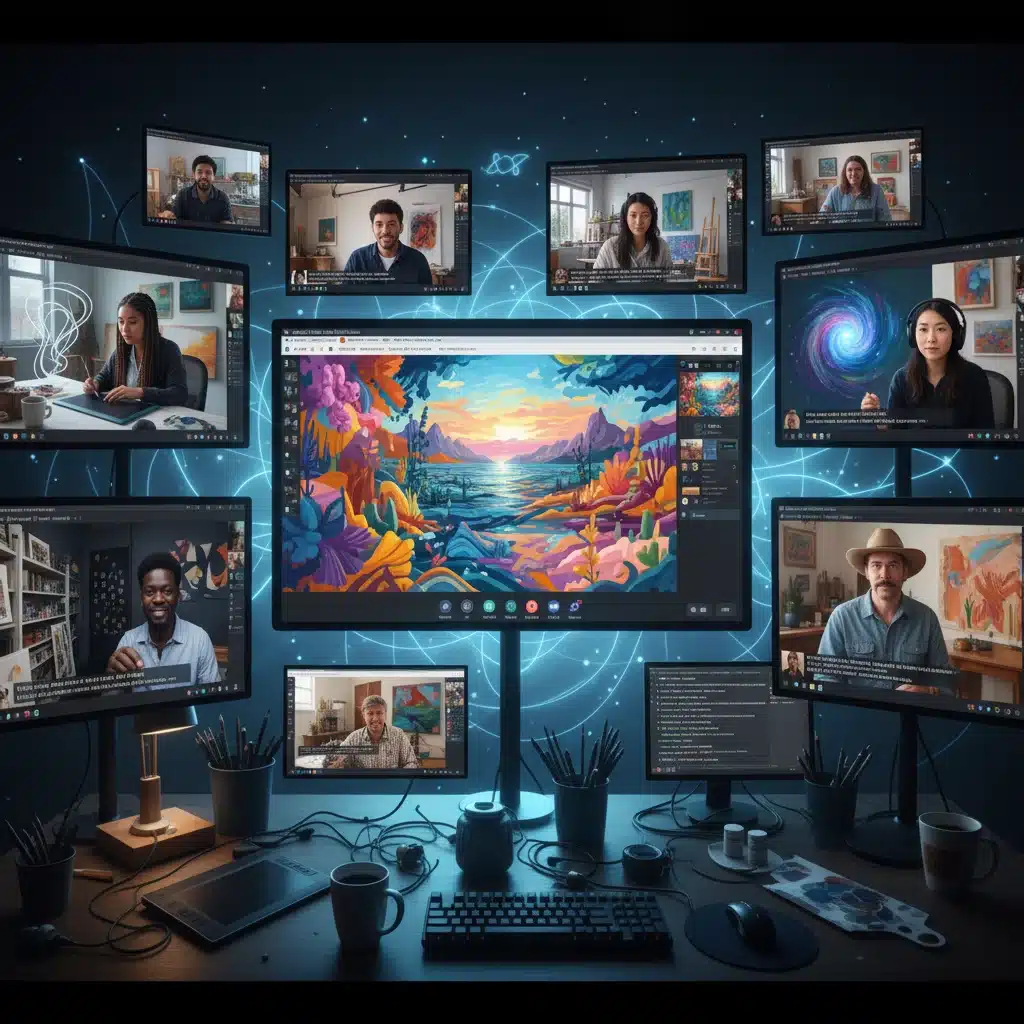
7. Wacom Cintiq/Intuos and Apple iPad Pro with Apple Pencil: Hardware Essentials
While software drives the creative process, the hardware provides the tactile interface. For digital tools artists, a reliable and responsive drawing tablet is as important as a canvas is to a painter. Wacom’s Cintiq and Intuos lines, alongside the Apple iPad Pro with Apple Pencil, remain the gold standard for digital input devices in 2026.
Wacom Cintiq display tablets offer a direct drawing experience, allowing artists to draw directly on the screen with a pressure-sensitive pen. This ‘pen-on-screen’ interaction is incredibly intuitive and mimics traditional drawing more closely than a non-display tablet. Cintiqs are available in various sizes, catering to different desk setups and artistic preferences, and are favored by professionals for their precision, build quality, and long-term reliability.
The Wacom Intuos series, while not featuring a display, offers excellent value and precision. These tablets connect to a computer, and artists draw on the tablet surface while looking at their monitor. They are highly ergonomic, durable, and provide excellent pressure sensitivity, making them a fantastic entry point for aspiring digital artists or a preferred choice for those who prefer not to draw directly on a screen.
The Apple iPad Pro, when paired with the Apple Pencil, transforms into a powerful standalone creative device. Its ProMotion display offers incredible responsiveness, and the Apple Pencil’s precision and low latency make for a highly natural drawing experience. Coupled with apps like Procreate (discussed earlier) and other powerful creative applications, the iPad Pro offers unparalleled portability and versatility, making it a favorite for artists who need to create on the go.
Choosing between these hardware options often comes down to personal preference, budget, and workflow. However, investing in high-quality input hardware is crucial for any digital artist, as it directly impacts comfort, precision, and the overall enjoyment of the creative process. As technology advances, we can expect even more refined pressure sensitivity, improved display technologies, and potentially new haptic feedback mechanisms in these devices by 2026.
The Future of Digital Tools for US Artists
The landscape of digital tools artists utilize is constantly evolving, driven by advancements in artificial intelligence, virtual reality, and cloud computing. By 2026, we anticipate even deeper integration of AI into creative software, offering intelligent assistance for everything from generating initial concepts to automating complex rendering tasks. VR and AR technologies are also poised to create new immersive art-making experiences, allowing artists to sculpt and paint in 3D space with unprecedented freedom.
Cloud-based collaboration will become even more seamless, enabling artists from different corners of the US and the world to work together on projects in real-time, sharing assets and iterating on designs effortlessly. The rise of NFTs and blockchain technology will continue to offer new avenues for artists to monetize their digital creations and protect their intellectual property, although the market dynamics will likely stabilize and mature.
For US artists, the key to thriving in this dynamic environment is continuous learning and adaptability. Exploring new tools, experimenting with different workflows, and staying connected with the broader artistic community will be crucial for unlocking new creative potential and building a sustainable career. The tools listed above represent the current pinnacle of digital artistry, but the future promises even more exciting possibilities.
Conclusion
The journey of an artist is one of perpetual discovery and expression. In 2026, the array of digital tools artists have at their disposal is more powerful and diverse than ever before. From the comprehensive suite of Adobe Creative Cloud to the portable prowess of Procreate, the democratic power of Blender, and the efficient alternatives of Affinity Suite, creation software continues to push the boundaries of what’s possible.
Equally important are the platforms like Artstation and Behance that facilitate networking and portfolio showcasing, and organizational tools like Notion and Milanote that bring order to the creative chaos. And underpinning it all, the essential hardware from Wacom and Apple provides the tactile connection between artistic intent and digital execution.
By thoughtfully integrating these top 7 digital tools into their practice, US artists can not only enhance their technical skills but also broaden their creative horizons, connect with a global audience, and solidify their place in the vibrant and ever-expanding world of digital art. Embrace these innovations, and watch your artistic journey flourish in 2026 and beyond.