Augmented Reality in Education: 6 Practical Applications for US Learning Environments by Fall 2026
The landscape of education is continuously evolving, driven by technological advancements that promise to reshape how students learn and interact with information. Among these innovations, Augmented Reality Education (AR) stands out as a particularly transformative force. Far from being a futuristic pipe dream, AR is rapidly becoming a tangible tool in classrooms across the United States. By Fall 2026, we anticipate a significant surge in its practical applications, offering immersive, interactive, and highly engaging learning experiences that were once confined to science fiction.
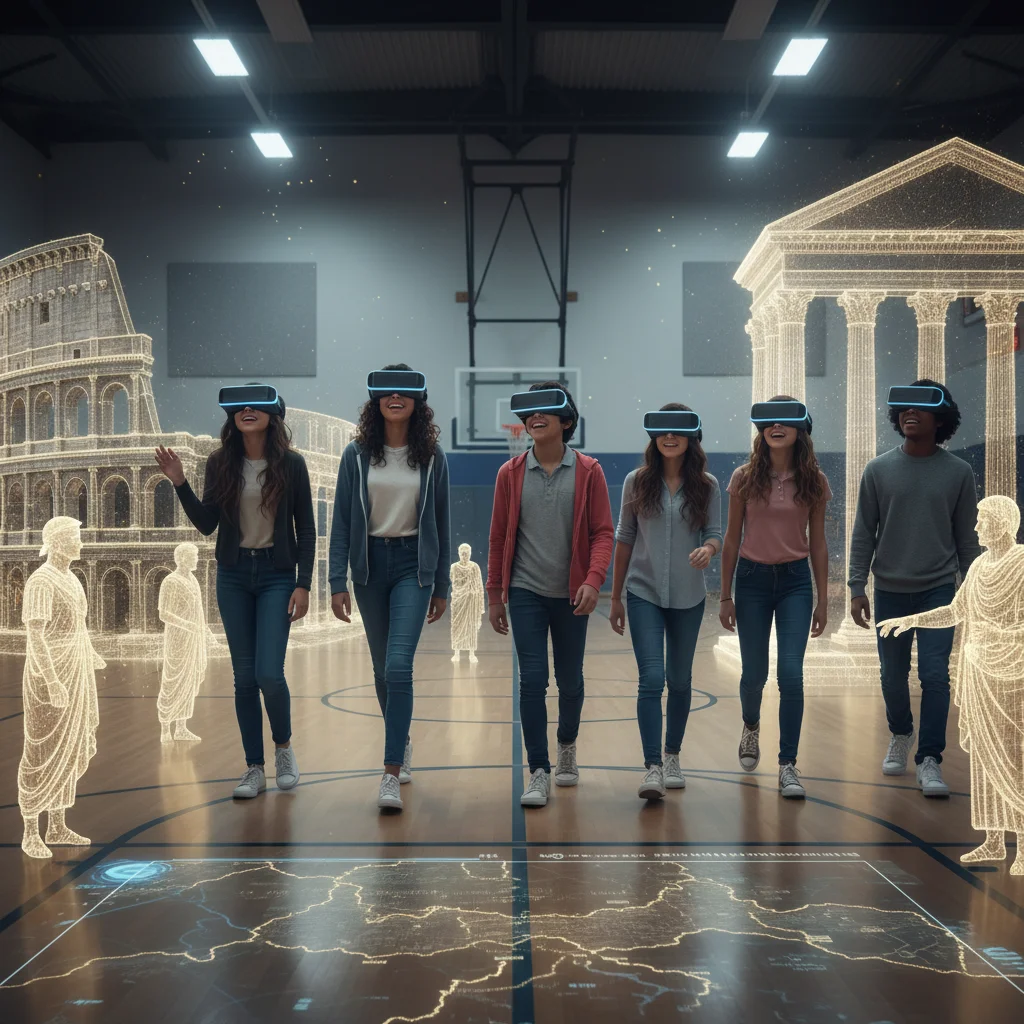
Augmented Reality, often confused with Virtual Reality (VR), differentiates itself by overlaying digital information onto the real world, rather than creating an entirely simulated environment. This unique characteristic makes AR exceptionally well-suited for educational settings, as it allows students to remain connected to their physical surroundings while simultaneously interacting with rich, dynamic digital content. Imagine dissecting a virtual frog on a real lab table, exploring the internal combustion engine of a car projected onto a classroom desk, or walking through ancient Rome as if you were truly there – all without leaving the classroom. These are not just fanciful ideas; they are the practical applications of Augmented Reality Education that are already being piloted and will become mainstream in US learning environments very soon.
The integration of AR into education is driven by several compelling factors. Firstly, it caters to diverse learning styles, particularly visual and kinesthetic learners, by providing hands-on, experiential opportunities. Secondly, it fosters deeper understanding of complex concepts by visualizing abstract ideas in three dimensions. Thirdly, it significantly boosts student engagement and motivation, turning passive learning into an active exploration. As educators and technologists collaborate to harness its full potential, the impact of Augmented Reality Education on student outcomes is poised to be profound. This article will delve into six key practical applications that are set to redefine the learning experience in US schools and universities by Fall 2026.
1. Interactive Textbooks and Learning Materials
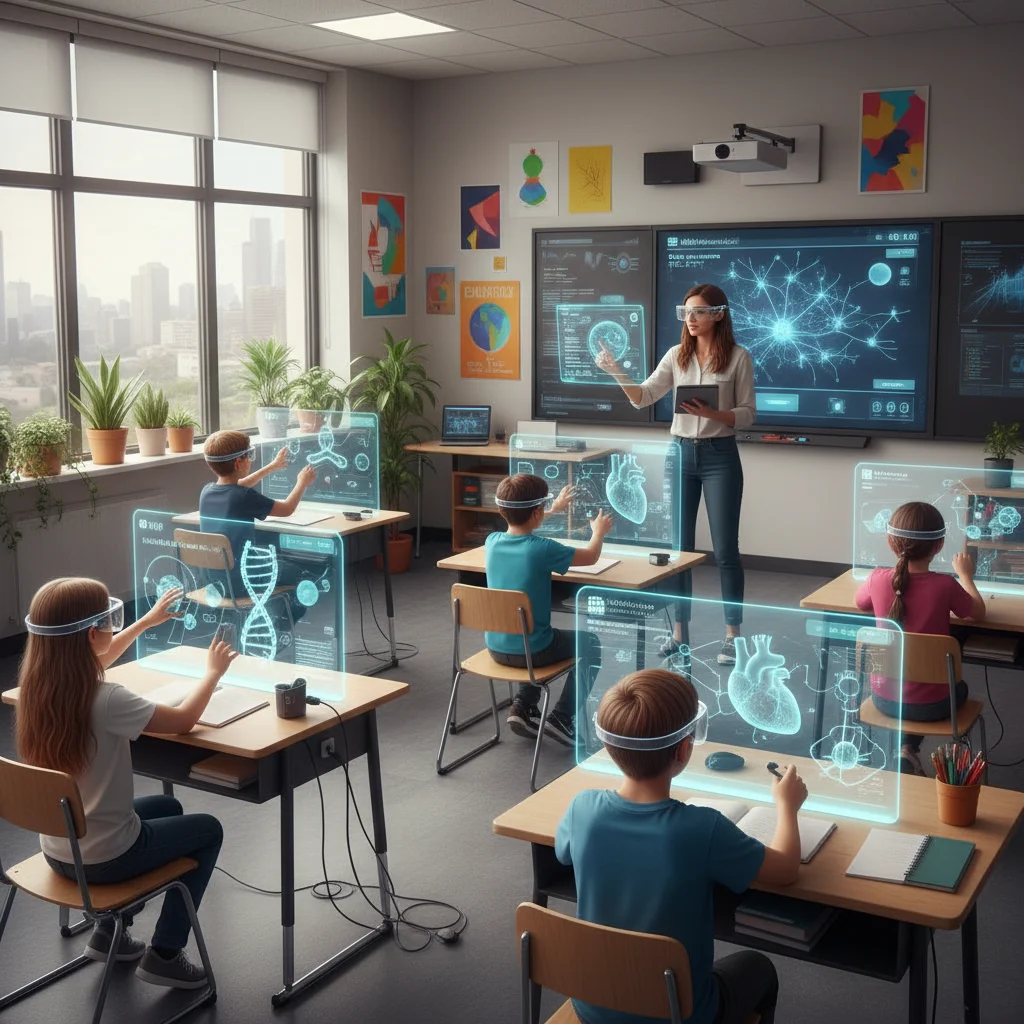
Gone are the days when textbooks were static repositories of information. With the advent of Augmented Reality Education, textbooks are transforming into dynamic, interactive portals to knowledge. By Fall 2026, it will be common for students to point their smartphones or tablets at a page in a textbook and see 3D models pop up, animations explaining complex processes, or even interactive quizzes appearing directly on the page. This application breathes new life into traditional learning materials, making them far more engaging and effective.
Consider a biology textbook: instead of a flat diagram of the human circulatory system, students could view a pulsing, animated 3D heart that they can rotate, zoom into, and even interact with to understand blood flow. A history textbook could bring ancient civilizations to life, showing animated battles or architectural reconstructions directly on the page. Chemistry students could visualize molecular structures in three dimensions, manipulating them to understand bonding and reactions. This level of interaction not only enhances comprehension but also makes learning more memorable and enjoyable.
Publishers and educational technology companies are already investing heavily in developing AR-enhanced textbooks and supplementary materials. These resources provide a richer context for learning, allowing students to explore concepts at their own pace and revisit them as needed. The ability to overlay digital content onto physical objects bridges the gap between abstract concepts and real-world understanding, making learning more concrete and accessible. This shift will fundamentally change how students interact with their core educational resources, moving from passive reading to active exploration with Augmented Reality Education.
2. Virtual Field Trips and Immersive Explorations
One of the most exciting prospects of Augmented Reality Education is its ability to transcend geographical and temporal boundaries, offering students unparalleled opportunities for virtual field trips. By Fall 2026, a classroom in Kansas could virtually explore the Amazon rainforest, walk through the streets of ancient Rome, or even visit the International Space Station, all without ever leaving the school premises. This application democratizes access to experiences that would otherwise be impossible or prohibitively expensive for many schools.
Imagine a history lesson where students, through AR-enabled devices, can see historical figures appear in their classroom, delivering speeches or demonstrating historical events. Science classes could conduct virtual expeditions to volcanic sites, deep-sea trenches, or even the surface of Mars, observing phenomena up close and collecting data in a simulated environment. Art students could wander through virtual galleries featuring masterworks from around the world, examining brushstrokes and artistic techniques in detail.
These immersive explorations offer a level of engagement and contextual understanding that traditional teaching methods simply cannot match. They ignite curiosity, foster a sense of wonder, and make learning an unforgettable adventure. The logistical challenges and costs associated with physical field trips are entirely circumvented, making these rich educational experiences accessible to every student, regardless of their socioeconomic background or geographical location. The impact on global awareness and interdisciplinary learning will be immense, driven by advancements in Augmented Reality Education.

3. Enhanced Science Labs and Dissections
Science education, particularly in subjects requiring hands-on experimentation and dissection, is set to be revolutionized by Augmented Reality Education. Traditional science labs often involve expensive equipment, hazardous materials, and, in the case of biology, ethical concerns surrounding animal dissection. AR offers a safe, cost-effective, and highly effective alternative that enhances the learning experience without these drawbacks.
By Fall 2026, students will be able to perform virtual dissections of animals, such as frogs or fetal pigs, using AR applications. They can manipulate virtual organs, identify anatomical structures, and understand physiological processes in a realistic 3D environment, all while using a real dissection tray and tools. This eliminates the need for actual specimens, reducing costs, ethical concerns, and potential exposure to chemicals, while still providing a deeply interactive and educational experience.
Beyond dissections, AR can transform other science experiments. Chemistry students could safely conduct virtual experiments involving dangerous chemicals, observing reactions and outcomes without any risk. Physics students could visualize abstract concepts like force fields, wave propagation, or quantum mechanics directly within their physical lab space. This allows for repeated experimentation, error correction, and a deeper conceptual understanding, making science more accessible and less intimidating. The practical implications for STEM education are enormous, positioning Augmented Reality Education as a cornerstone of future scientific inquiry.
4. Vocational Training and Skill Development
The applications of Augmented Reality Education extend beyond traditional academic subjects into vocational training and skill development, offering realistic and safe environments for practical learning. By Fall 2026, AR will be widely used in trade schools, technical colleges, and vocational programs to train students in various hands-on professions, from automotive repair to healthcare.
Consider aspiring mechanics: instead of disassembling a real engine, which can be time-consuming and costly, an AR application could overlay detailed instructions, part labels, and animated repair procedures directly onto a physical engine. Students could practice complex tasks, identify components, and troubleshoot issues in a guided, interactive manner. Similarly, in healthcare training, AR can simulate medical procedures on mannequins, providing real-time feedback and allowing students to practice critical skills in a risk-free environment.
For construction trades, AR can project blueprints onto a job site, guiding workers through installation steps or identifying potential issues before they become costly mistakes. In manufacturing, AR can assist in assembly processes, providing step-by-step visual instructions directly on the components. This type of training is not only highly effective but also accelerates skill acquisition, reduces training costs, and enhances safety. The ability to practice complex tasks repeatedly in a simulated yet real-world context makes Augmented Reality Education an invaluable tool for preparing the next generation of skilled workers.
5. Collaborative Learning and Project-Based Activities
Augmented Reality Education has the potential to foster highly collaborative learning environments, encouraging students to work together on shared digital experiences. By Fall 2026, AR will facilitate project-based learning in ways previously unimaginable, allowing groups of students to interact with the same virtual objects and environments simultaneously.
Imagine a group of architecture students collaborating on a building design. Through AR, they could project a 3D model of their design onto a table, walking around it, making real-time adjustments, and discussing structural elements as if the building were physically present. Similarly, in a geography class, students could collaboratively explore a virtual topographic map, identifying landforms, analyzing climate patterns, and discussing environmental impacts, all while seeing the same interactive data overlays.
This collaborative aspect of AR breaks down barriers between individual learning and group work, transforming classrooms into dynamic hubs of collective discovery. Students can share their perspectives, contribute to a common virtual project, and learn from each other in a deeply immersive setting. The technology supports problem-solving, critical thinking, and teamwork – essential skills for the 21st century. The shared experience facilitated by Augmented Reality Education will make group projects more engaging, productive, and ultimately, more impactful.
6. Personalized Learning and Adaptive Content Delivery
One of the most significant promises of educational technology is its ability to personalize the learning experience for each student. Augmented Reality Education is uniquely positioned to deliver on this promise by providing adaptive content and individualized feedback. By Fall 2026, AR applications will be able to tailor educational content to a student’s specific needs, learning pace, and preferred style.
For example, an AR application could identify that a student is struggling with a particular mathematical concept. It could then dynamically generate additional interactive exercises, provide step-by-step visual explanations projected into their physical space, or even summon a virtual tutor to offer personalized guidance. Conversely, for advanced learners, AR could offer more complex challenges, deeper dives into topics, or opportunities for independent research within an augmented environment.
This adaptive nature of AR allows for a truly differentiated instruction model. Students can progress at their own speed, focusing on areas where they need more support and accelerating through content they have already mastered. The immediate feedback provided by AR systems helps students understand their mistakes in context and learn from them effectively. This personalized approach, powered by Augmented Reality Education, not only improves academic outcomes but also fosters greater self-efficacy and a love for learning, ensuring that every student receives the support they need to succeed.
Challenges and the Road Ahead for Augmented Reality Education
While the potential of Augmented Reality Education is immense, its widespread adoption by Fall 2026 will not be without challenges. Infrastructure requirements, such as reliable Wi-Fi and capable devices, will need to be met across all learning environments. The cost of AR hardware and software, though decreasing, still presents a barrier for some institutions. Furthermore, educators will require comprehensive training to effectively integrate AR tools into their curriculum and pedagogy. Developing compelling and pedagogically sound AR content that aligns with learning objectives is another critical area that demands significant investment and innovation.
However, the rapid pace of technological advancement, coupled with increasing investment from both the public and private sectors, suggests that these challenges are surmountable. Governments and educational bodies are recognizing the transformative power of AR and are beginning to allocate resources for its implementation. Developers are creating more intuitive and accessible AR platforms, and the cost of devices is steadily declining. The focus on creating robust, curriculum-aligned content is also gaining momentum, ensuring that AR experiences are not just novel but genuinely educational.
The benefits of Augmented Reality Education – increased engagement, deeper understanding, personalized learning, and access to otherwise impossible experiences – far outweigh the hurdles. As these practical applications become more refined and widely available, they will undoubtedly reshape the educational landscape, preparing students with the skills and knowledge necessary to thrive in an increasingly digital and interconnected world. The journey towards a fully augmented classroom is well underway, and by Fall 2026, AR will be an indispensable component of modern US learning environments.
The Future is Augmented: Preparing for Fall 2026
The integration of Augmented Reality Education into US learning environments is not a distant dream but a rapidly approaching reality. The six practical applications discussed – interactive textbooks, virtual field trips, enhanced science labs, vocational training, collaborative learning, and personalized content delivery – represent just the tip of the iceberg of what AR can achieve. By Fall 2026, these applications will be commonplace, fundamentally altering how students engage with content, collaborate with peers, and develop critical skills.
Educators, administrators, and policymakers must proactively prepare for this shift. This involves investing in the necessary technological infrastructure, providing professional development for teachers, and fostering a culture of innovation that embraces new pedagogical approaches. The goal is not merely to adopt new technology for its own sake, but to leverage AR to create more effective, equitable, and inspiring learning experiences for all students.
The potential for Augmented Reality Education to democratize access to high-quality learning, spark curiosity, and empower students to become active participants in their education is immense. As we look towards Fall 2026, the augmented classroom promises to be a place where learning is not just about absorbing information, but about experiencing, exploring, and creating in ways that were once unimaginable. The future of education is indeed augmented, and it is poised to deliver a richer, more impactful learning journey for every student in the United States.