Unlock Your Potential: The Power of Micro-Habits for 1% Daily Improvement

In a world that constantly pushes for monumental shifts and overnight transformations, the concept of the power of micro-habits often gets overshadowed. We are conditioned to believe that significant results demand significant effort, grand gestures, and radical overhauls. However, what if the secret to achieving extraordinary success and sustainable personal growth lies not in drastic changes, but in the subtle, almost imperceptible act of 1% daily improvement?
This article delves deep into the transformative potential of micro-habits, exploring how these tiny, consistent actions can pave the way for remarkable achievements across all facets of your life. We will uncover the psychology behind why micro-habits are so effective, provide practical strategies for implementing them, and illustrate how this seemingly small approach can lead to monumental long-term success. By the end of this comprehensive guide, you will have a clear roadmap to harness the power of micro-habits and embark on your journey of continuous, effortless improvement.
The Illusion of Grand Gestures: Why Big Changes Often Fail
Before we fully embrace the power of micro-habits, it’s crucial to understand why our traditional approach to self-improvement often falls short. New Year’s resolutions, ambitious diet plans, and sudden commitments to rigorous exercise routines are all born from a desire for rapid, dramatic change. While the intention is noble, the execution often falters.
The primary reason for this high failure rate is the sheer magnitude of the change. Our brains are wired for efficiency and resistance to anything that feels too challenging or disruptive to our established routines. When faced with a massive undertaking, our willpower, a finite resource, quickly depletes. The initial burst of motivation fades, and we revert to our comfortable, albeit less productive, habits. This cycle of enthusiastic beginnings and disheartening relapses can lead to feelings of inadequacy and a belief that personal growth is an arduous, often impossible, task.
Moreover, big changes often require significant identity shifts. If you’ve always considered yourself a ‘couch potato,’ suddenly becoming a ‘marathon runner’ feels alien and unsustainable. This cognitive dissonance creates internal conflict, making it harder to stick to the new behavior. The pressure to maintain a perfect streak also plays a role; one missed day can feel like a complete failure, leading to abandonment of the entire goal.
This is where the subtle yet profound wisdom of the power of micro-habits comes into play. Instead of trying to leap across a chasm, we learn to build a bridge, one tiny, sturdy plank at a time.
Understanding the 1% Daily Improvement Principle
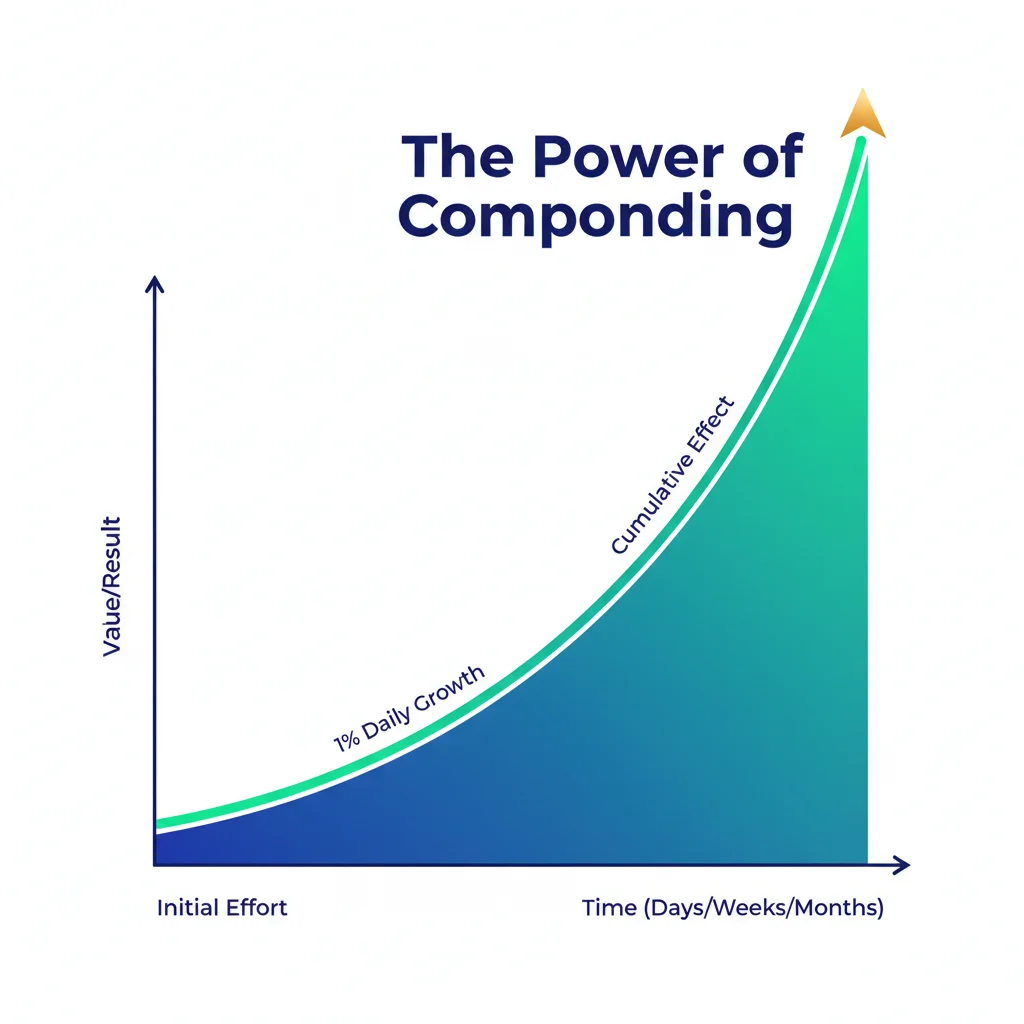
The concept of 1% daily improvement is a cornerstone of the power of micro-habits. It’s elegantly simple: if you get just 1% better at something every day, the results compound over time, leading to astonishing progress. Conversely, if you get 1% worse each day, the decline is equally dramatic.
Let’s do a quick calculation to appreciate this. If you improve by 1% every day for a year, you’ll be 37 times better (1.01^365 ≈ 37.78) than when you started. On the other hand, if you decline by 1% each day, you’ll be nearly down to zero (0.99^365 ≈ 0.025). This mathematical reality underscores the profound impact of small, consistent actions, both positive and negative.
The Compound Effect in Action
This principle is often referred to as the compound effect, famously popularized by Darren Hardy. Just like compound interest in finance, where your earnings generate more earnings, the positive effects of small habits accumulate and multiply over time. A single push-up today might seem insignificant, but a push-up every day for a year, perhaps gradually increasing to two, then three, builds strength, discipline, and a foundation for more intense workouts. Reading one page of a book daily might seem trivial, but over a year, you’ve read several books, expanding your knowledge and perspective significantly.
The beauty of 1% daily improvement is that it bypasses the resistance our brains have to large changes. It feels manageable, almost effortless, and thus sustainable. It doesn’t trigger the ‘too hard’ response that often derails our best intentions. This is the true essence of the power of micro-habits: making progress so small it’s almost unnoticeable in the short term, but undeniably transformative in the long run.
What Exactly Are Micro-Habits?
Micro-habits are incredibly small, simple actions that require minimal effort and time, yet are performed consistently to build momentum towards a larger goal. They are so tiny that it’s almost impossible to fail at them, making them incredibly effective for habit formation.
The key characteristics of a micro-habit are:
- Tiny: They take less than a minute to complete.
- Easy: They require virtually no willpower or motivation.
- Specific: They are clearly defined actions, not vague intentions.
- Anchored: They are typically linked to an existing habit or a specific time/trigger.
For example, instead of aiming to ‘exercise for 30 minutes daily,’ a micro-habit might be ‘do one push-up after brushing my teeth.’ Instead of ‘write a book,’ it could be ‘write one sentence after making coffee.’ Instead of ‘meditate for 20 minutes,’ it could be ‘take one deep breath after sitting down at my desk.’
The goal isn’t the immediate impact of the action itself, but the consistency it builds and the identity it reinforces. By consistently performing a micro-habit, you’re telling yourself, ‘I am the kind of person who exercises,’ ‘I am the kind of person who writes,’ ‘I am the kind of person who meditates.’ This identity shift is profoundly powerful and lays the groundwork for more significant habits to emerge naturally.
The Psychological Edge: Why Micro-Habits Work So Well
The effectiveness of the power of micro-habits isn’t just anecdotal; it’s rooted in established psychological principles:
1. Overcoming Activation Energy
Every task has an ‘activation energy’ – the initial effort required to start. Large tasks have high activation energy, making them daunting. Micro-habits drastically reduce this energy. It’s far easier to start with ‘one push-up’ than to gear up for a ’30-minute workout.’ Once you start, even with a tiny action, the momentum often carries you further than you originally intended. This phenomenon is known as the Diderot Effect in reverse – starting small prevents the overwhelming cascade of perceived effort.
2. Building Self-Efficacy and Confidence
Each successful completion of a micro-habit provides a small win. These consistent wins build self-efficacy – your belief in your ability to succeed. Every time you do that one push-up, you reinforce the idea that you are capable of achieving your goals. This cumulative confidence is crucial for tackling larger challenges down the line.
3. Reducing Decision Fatigue
Our willpower and decision-making capacity are finite. The more decisions we have to make, the more fatigued we become. Micro-habits, especially when anchored, remove the need for constant decision-making. You don’t decide if you’re going to do ‘one push-up after brushing your teeth’; it simply becomes an automatic sequence.
4. Creating Habit Loops
Micro-habits leverage the habit loop: Cue → Routine → Reward. By anchoring a new micro-habit to an existing cue (like brushing teeth or making coffee), the routine becomes automatic. The reward is often internal – the feeling of accomplishment, the reinforcing of your desired identity, or even a small, immediate pleasure you associate with the completion (e.g., a sip of coffee after writing a sentence). This loop strengthens the neural pathways associated with the new behavior.
5. Identity-Based Habit Formation
As James Clear eloquently explains in ‘Atomic Habits,’ true habit change is identity change. When you consistently perform a micro-habit, you are casting a vote for the type of person you want to become. ‘I write one sentence’ isn’t just about writing; it’s about becoming a writer. This internal shift is far more powerful and sustainable than simply focusing on outcome-based goals.
Practical Strategies for Implementing Micro-Habits
Now that we understand the ‘why,’ let’s dive into the ‘how’ of leveraging the power of micro-habits.
Step 1: Identify Your Desired Outcome (Big Goal)
Start with a larger goal you want to achieve. Do you want to be healthier? More knowledgeable? A better writer? More organized? For example, let’s say your big goal is to ‘write a novel.’
Step 2: Break it Down into Tiny Actions
What’s the absolute smallest action you can take towards that goal? If it’s writing a novel, a micro-habit could be ‘write one sentence.’ If it’s getting healthier, it could be ‘drink one glass of water.’
Step 3: Find an Anchor (Existing Habit)
This is crucial. Link your new micro-habit to something you already do consistently every day. This provides the ‘cue’ for your new habit. Examples:
- After I brush my teeth, I will do one push-up.
- After I make my coffee, I will write one sentence.
- After I sit down at my desk, I will take one deep breath.
- After I turn off the TV, I will read one page of a book.

Step 4: Make It Ridiculously Easy
The micro-habit must be so small that it feels almost silly not to do it. If ‘one push-up’ feels too hard, make it ‘get into push-up position.’ If ‘write one sentence’ feels too hard, make it ‘open my writing document.’ The goal is to build consistency, not intensity, at this stage.
Step 5: Reward Yourself (Even if it’s Internal)
Immediately after performing your micro-habit, give yourself a small reward. This reinforces the behavior. It could be a mental pat on the back, a sip of your favorite drink, or simply ticking it off a small habit tracker. The positive feeling associated with completion is a powerful motivator.
Step 6: Track Your Progress (Optional, but Recommended)
Seeing your streak grow can be incredibly motivating. A simple calendar where you put an ‘X’ for each day you complete your micro-habit can work wonders. Apps like Streaks or Habitica can also be helpful.
Step 7: Scale Up Gradually (Only When Consistent)
Once your micro-habit feels automatic and you consistently perform it without much thought, you can consider incrementally increasing it. For example, from one push-up to two, then three. From one sentence to two sentences, then a paragraph. But only do this when the smaller habit is firmly established. The beauty is that often, once you start, you’ll naturally want to do more anyway.
Examples of Micro-Habits for Various Goals
Let’s look at how the power of micro-habits can be applied to different areas of life:
For Health & Fitness:
- Goal: Get more active.
- Micro-habit: After pouring my morning coffee, I will do 5 squats.
- Goal: Drink more water.
- Micro-habit: After every bathroom break, I will drink a small glass of water.
- Goal: Eat healthier.
- Micro-habit: Before every meal, I will eat one bite of a vegetable.
For Productivity & Career:
- Goal: Improve focus.
- Micro-habit: Before starting a new task, I will close all unnecessary tabs.
- Goal: Learn a new skill.
- Micro-habit: After opening my laptop, I will spend 2 minutes on a language learning app.
- Goal: Be more organized.
- Micro-habit: Before leaving my desk for the day, I will clear one item off it.
For Personal Growth & Well-being:
- Goal: Practice mindfulness.
- Micro-habit: After turning off my alarm, I will take three deep breaths.
- Goal: Read more.
- Micro-habit: Before I get into bed, I will read one page of a book.
- Goal: Express gratitude.
- Micro-habit: While waiting for my computer to boot up, I will think of one thing I’m grateful for.
The possibilities are endless. The key is to make it so small that it feels like almost no effort at all. This is the secret sauce of the power of micro-habits.
Overcoming Challenges and Staying Consistent
Even with micro-habits, consistency can sometimes be a challenge. Here are some tips to keep you on track:
1. Don’t Break the Chain
Jerry Seinfeld’s productivity method, ‘Don’t Break the Chain,’ is perfect for micro-habits. Mark an ‘X’ on a calendar for each day you complete your habit. The goal is to build a long chain of Xs. The visual representation of your progress is a powerful motivator.
2. Embrace Imperfection
Life happens. You might miss a day. Don’t let one missed day derail your entire effort. The ‘all or nothing’ mentality is a habit killer. Instead, adopt the ‘never miss twice’ rule. If you miss today, make sure you get back on track tomorrow. Forgive yourself and move on.
3. Re-evaluate and Adjust
If a micro-habit consistently feels too hard, even after several attempts, it might still be too big. Break it down further. Or perhaps the anchor isn’t strong enough. Don’t be afraid to experiment and adjust until you find what works for you.
4. Focus on the Process, Not Just the Outcome
While the big goal is important, the true power of micro-habits lies in the process. Celebrate the act of showing up and doing the small thing, regardless of how far it seems from your ultimate goal. Each small action reinforces your identity as someone who is committed to growth.
5. Environmental Design
Make it easier to do the right thing and harder to do the wrong thing. If your micro-habit is to read one page, keep a book on your bedside table. If it’s to drink water, keep a full glass of water visible on your desk. Remove friction points that prevent you from taking action.
The Long-Term Impact: From Micro to Macro Success
The true magic of the power of micro-habits unfolds over time. What starts as an almost insignificant action eventually transforms into a powerful routine, and these routines, when compounded, lead to extraordinary results.
Consider the example of someone who wants to learn a new language. Starting with ‘study for 30 minutes daily’ might be overwhelming. But ‘open the language app for 2 minutes after lunch’ is manageable. Over weeks, this becomes automatic. After a few weeks, those 2 minutes might naturally extend to 5, then 10, as proficiency and confidence grow. The initial resistance is overcome, and the identity of a ‘language learner’ is solidified.
Similarly, a person aiming for financial freedom might start with ‘review my budget for 5 minutes every Sunday.’ This micro-habit builds awareness and discipline, which can then naturally lead to more significant actions like identifying saving opportunities, investing, and making smarter financial decisions. The 1% daily improvement isn’t just about the small action itself; it’s about the domino effect it creates, influencing other positive behaviors and fostering a growth mindset.
The consistent application of micro-habits also cultivates patience and resilience. You learn to appreciate the journey, understanding that significant progress is a marathon, not a sprint. This mindset shift is invaluable in all areas of life, equipping you with the mental fortitude to pursue long-term goals without succumbing to instant gratification.
The Power of Micro-Habits in 2026 and Beyond
As we look towards the future, the relevance of the power of micro-habits only grows. In an increasingly fast-paced and demanding world, the ability to make consistent, sustainable progress without burning out is a critical skill. Micro-habits offer a powerful antidote to overwhelm, allowing individuals to navigate complex challenges and achieve ambitious goals one tiny step at a time.
In 2026, and in the years to come, those who master the art of micro-habits will be the ones who consistently innovate, learn, and adapt. They will be the ones who build resilience, maintain well-being, and ultimately, achieve their full potential, not through heroic efforts, but through the quiet, persistent accumulation of small, positive choices.
Conclusion: Embrace the Tiny Path to Tremendous Success
The journey to personal growth and success doesn’t always require a giant leap. More often than not, it’s the aggregation of marginal gains, the consistent application of tiny, almost unnoticeable efforts, that leads to truly remarkable transformations. The power of micro-habits is a testament to this truth: that 1% daily improvement, sustained over time, can yield results far beyond what we initially imagine.
By understanding the psychology behind habit formation, breaking down intimidating goals into ridiculously small actions, and anchoring these actions to existing routines, you can create an unstoppable engine of progress. So, stop waiting for the perfect moment or the surge of motivation to make grand changes. Start small. Start now. Embrace the quiet strength of micro-habits, and watch as your life gradually, yet profoundly, transforms, one daily 1% improvement at a time.
What micro-habit will you start today to unlock your potential for 2026 and beyond?